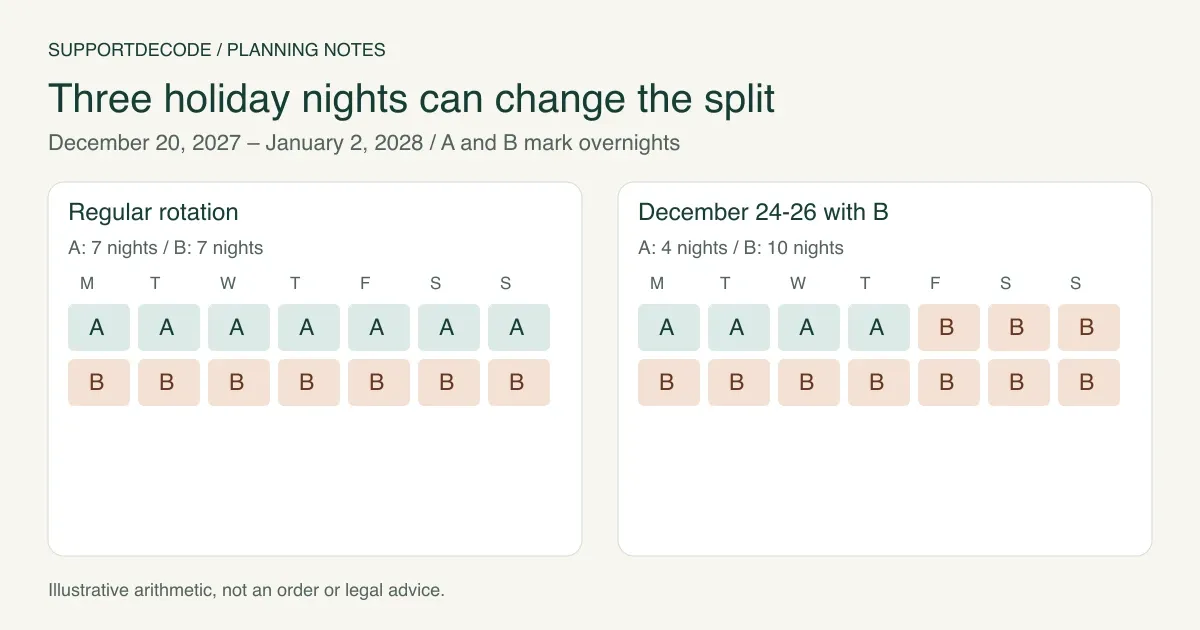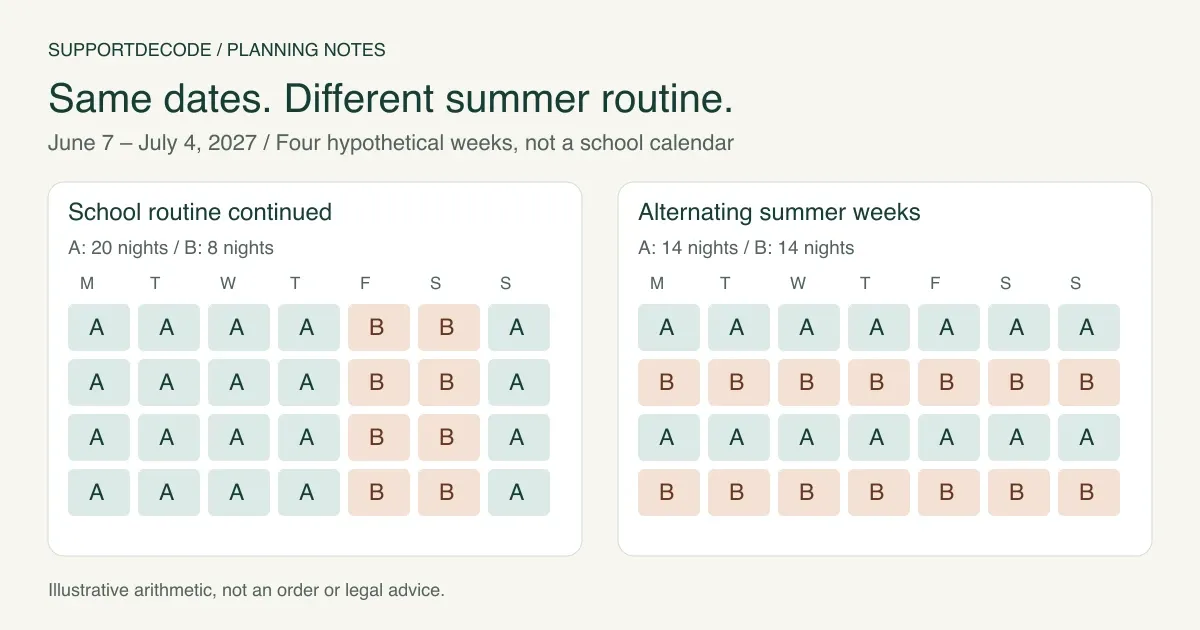
A literal 40 percent of a 365-night year is 146 overnights. The weekly rotation commonly called 60/40 gives the second parent 3 of every 7 nights, or about 156 overnights a year. The ten-night difference comes from using a rounded schedule name for a 4-3 weekly calendar.
Why 60/40 can mean 146 or 156 nights
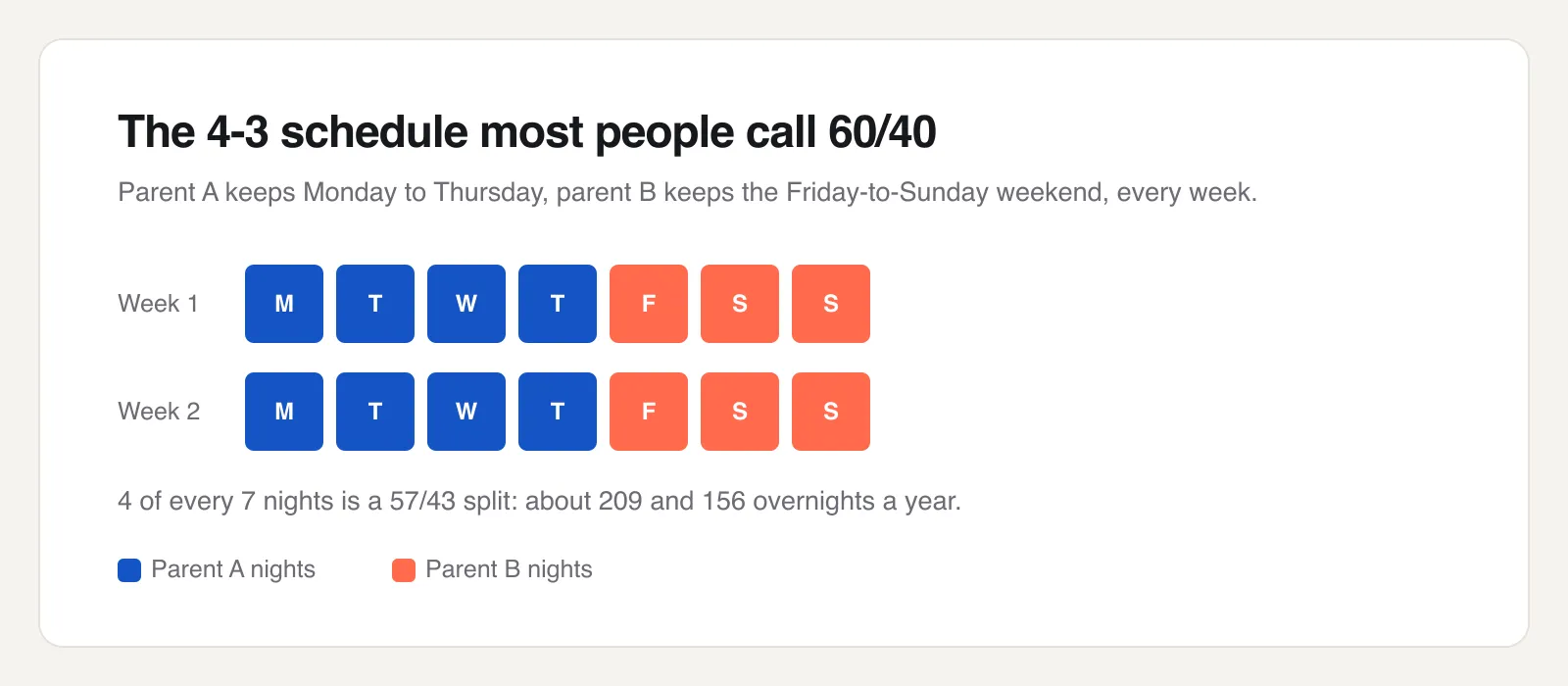
A strict percentage calculation gives the minority-time parent 365 multiplied by 0.40, which is 146 nights after rounding. In practice, “60/40” often describes the 4-3 rotation: parent A has the same four nights every week, usually Monday through Thursday, and parent B has Friday, Saturday, and Sunday. Three sevenths is 42.9 percent, not 40 percent, so that weekly pattern produces about 156 nights.
Unlike 50/50 rotations, nothing alternates. Parent B gets every weekend, parent A gets every school night, and both households can build fixed routines around that. The trade is obvious once you say it out loud: one parent becomes the homework parent, the other the weekend parent, permanently.
The weekly 4-3 calendar is really 57/43
Three nights out of seven is 42.9 percent, which over a year gives parent B about 156 overnights, not the 146 that a literal 40 percent of 365 would be. Schedule names round to friendly numbers; formulas do not. If a support calculation or a shared-custody threshold rides on the count in your state, run the real total for the real calendar rather than trusting the label. The overnight conversion table covers every split, and the parenting time calculator counts your exact plan.
Changes that move the overnight count
The plain 4-3 gives one parent every weekend, and that is the most common complaint about it. Three fixes show up in real parenting plans:
- Rotating the weekend occasionally. Some plans give parent A one weekend a month, compensated with midweek nights to parent B that week. The split stays near 60/40 while both parents get some Saturdays.
- Shifting the boundary. Extending the weekend to Thursday night gives the weekend parent four nights and lands the split nearly even; trimming it to Saturday and Sunday only pushes the arrangement toward 70/30. The weekend boundary is the tuning knob.
- The 60/40 as a stepping stone. Families moving from an every-other-weekend arrangement toward equal time often pass through a 4-3 year first, letting a younger child adjust to more nights away before a full 50/50 rotation.
Who the 4-3 fits
The schedule works best when the parents’ lives are genuinely asymmetric: one has weekday evenings free for homework and activities, the other works weekdays late but keeps weekends clear. It also suits children who do better with one consistent school-week base. It fits poorly when both parents want school-night involvement, which is usually the point where families move to a 2-2-5-5 instead; that comparison is laid out in the 2-2-5-5 visual guide.
Does 60/40 custody change child support?
It can. Some state formulas account for overnights continuously, some switch methods at a state-specific threshold, and some do not apply an automatic overnight adjustment. A 156-night count therefore cannot predict the result without the governing state’s rule and the rest of the guideline inputs. The mechanics, with a worked example showing the same incomes at two different schedules, are in do you pay child support with 50/50 custody; at 60/40, the same state-specific inputs still control.
Test it on your real calendar
The 60/40 custody schedule page owns the full cycle explanation and breaks the rotation down night by night. The custody schedule generator lays that repeating rotation onto real dates. Holidays and school breaks are not added automatically, so compare the result with the controlling order before anything is signed.
Questions parents ask
What does 60/40 custody look like in a week?
Most commonly: Monday through Thursday nights with one parent, Friday through Sunday with the other, repeating every week with no alternation. Some families shift the boundary a night in either direction.
How many overnights is 60/40 custody?
A literal 40 percent of the year is 146 overnights. The common 4-3 weekly schedule actually delivers about 156, a 57/43 split, because 3 of 7 nights rounds to more than 40 percent.
How do you get to a 60/40 arrangement?
The same way any parenting schedule is set: by agreement written into the parenting plan, or by court order when parents cannot agree. Courts weigh best-interest factors, so a workable proposal with concrete logistics is more persuasive than a bare percentage.