
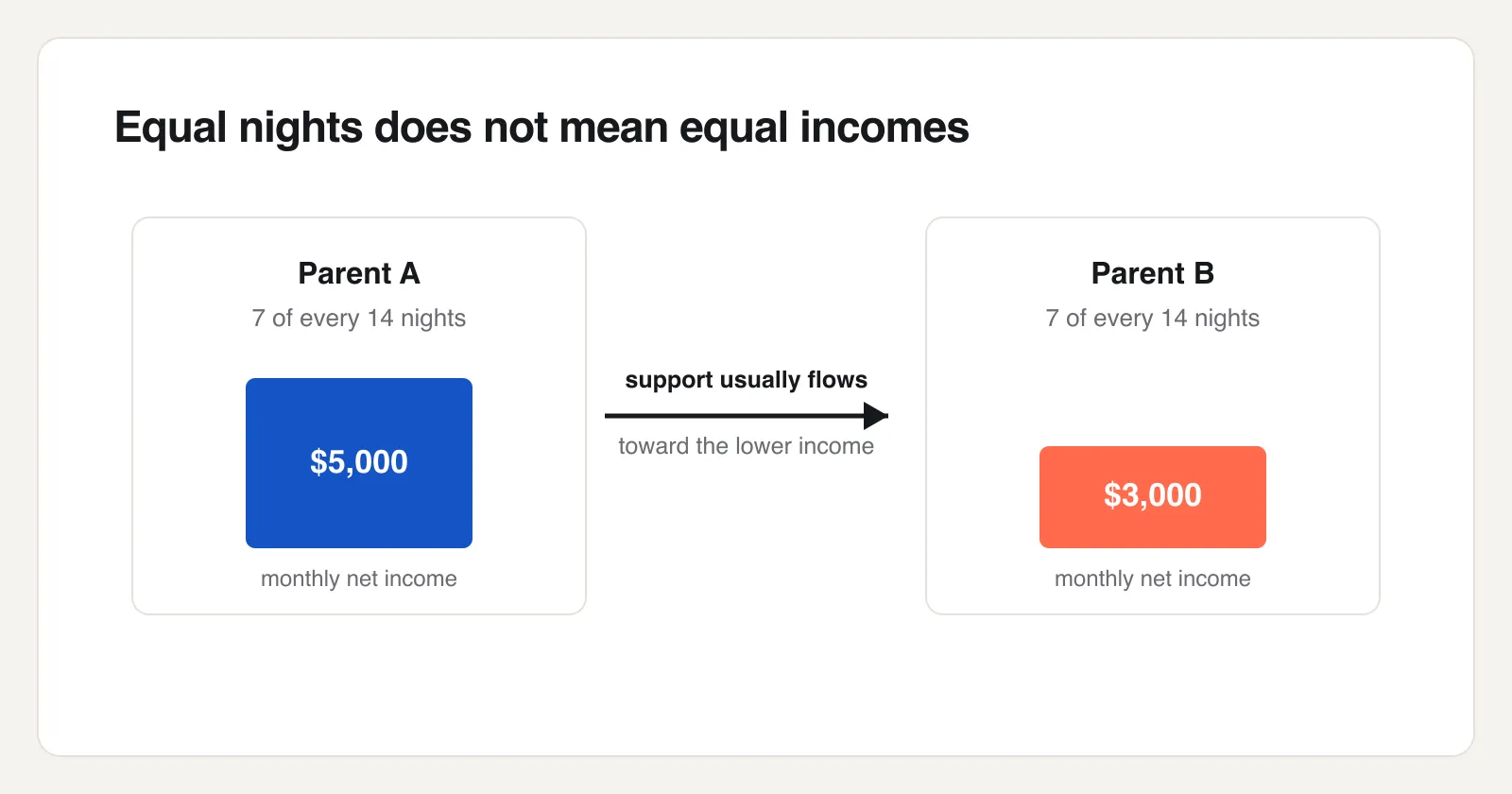
Splitting time equally feels like it should split the money equally too, and plenty of parents walk into mediation assuming a 50/50 schedule ends the child support question. It usually does not.
Here is why the math works that way, a real worked example from Florida, and how the rules differ in the states parents ask about most.
Why equal time does not cancel support
Most states build child support on the income shares idea: children should receive the same share of parental income they would have had in one household. Overnights matter in these formulas because the parent hosting the children more nights is already spending on them directly. But overnights are only half the input. The other half is income, and a 50/50 schedule does nothing to change who earns what.
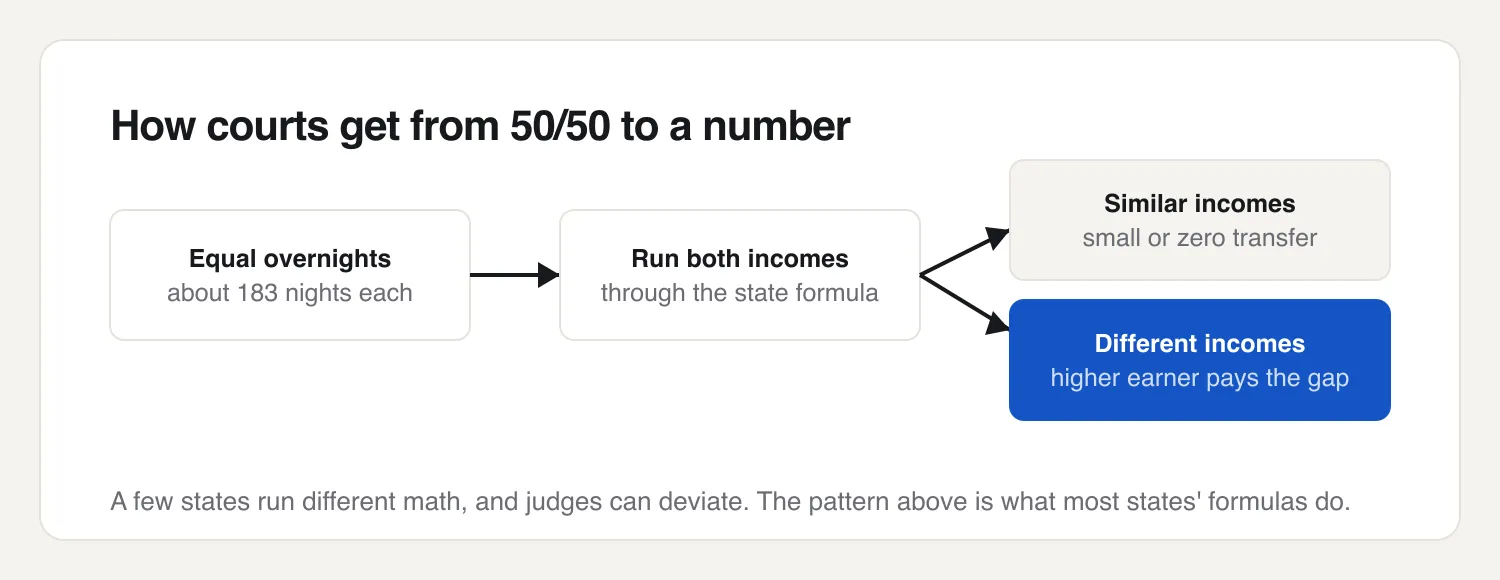
When time is equal, the formula runs both parents’ obligations and nets them against each other. Equal incomes make the two obligations cancel. Different incomes leave a gap, and the gap becomes the support payment, flowing toward the lower-earning household so the children live comparably in both homes.
A real example: the same family, two schedules
Take two Florida parents with monthly net incomes of $3,500 and $2,500 and 2 children. Florida’s formula switches methods once each parent has at least 73 overnights a year, multiplying the basic obligation by 1.5 and offsetting the two shares by both income and overnights.
| Schedule | Paying parent's overnights | Monthly transfer |
|---|---|---|
| Every other weekend | about 52 a year | $1,013.25 |
| Equal 50/50 rotation | 182 or 183 a year | $213.56 |
Two things worth noticing. The 50/50 schedule cut the payment by roughly four fifths, so time genuinely matters. And the payment did not reach zero, because a $1,000 monthly income gap remains whichever house the children sleep in. Both numbers come from running Florida’s statutory formula directly; our calculator reproduces them, and they are locked by automated tests against the real engine.
How the 50/50 rules differ by state
Every state answers the same two questions its own way: at what point does shared time start changing the math, and how strongly. A sample of verified rules:
| State | What the rule does |
|---|---|
| Florida | From 73 overnights (20%), the obligation is multiplied by 1.5 and offset by income and overnight shares |
| Maryland | Switches to the shared-physical-custody worksheet once a parent passes 92 overnights (25%) |
| Kentucky | A statutory shared-parenting credit begins at 88 days per year |
| Idaho | A 1.5 multiplier and offset apply once each parent has more than 25% of overnights |
| Alabama | Court-ordered 50/50 physical custody triggers a 150% offset under Rule 32 |
| Colorado | Every overnight counts from the first one, through a per-overnight parenting time table |
| Texas | Guideline support is a flat percentage of one parent's net resources; overnights usually do not change it |
Texas is the outlier worth underlining: because its guideline reads only the paying parent’s income, a Texas parent can move to a 50/50 possession schedule and see no automatic change in the guideline number at all. Courts there can deviate, but the formula itself does not count nights the way income shares states do.
When does 50/50 custody mean no support?
Three situations get a transfer to or near zero:
- Genuinely similar incomes. When both parents earn about the same, the offset formulas produce a small number or none at all.
- A court-approved deviation. Judges in most states can set support off-guideline when the case justifies it, with written findings. Parents can propose zero, but the court has to accept it.
- State-specific mechanics. A handful of offset formulas round small gaps down to nothing once both households clear self-support thresholds.
What parents cannot reliably do is privately agree to waive support and leave it out of the order. Courts treat support as the child’s right, and informal side deals tend to unravel the first time circumstances or cooperation change.
Run your own two numbers
The honest answer to “will I pay?” is a calculation, not a rule of thumb: your state, both incomes, and the exact overnight count. Run your real numbers with both schedules you are considering and compare, the way the Florida example above does.
For the schedule side of the decision, what 50/50 custody actually looks like compares the three common equal rotations, and the parenting time calculator turns any proposed calendar into the exact overnight count your state’s formula will read.
Questions parents ask
Who pays child support in 50/50 custody?
Usually the higher-earning parent. With equal overnights, most state formulas compute each parent's obligation and net them, so the parent with more income pays the difference to the other household.
Do you pay child support with 50/50 custody and equal incomes?
Often little or nothing. Equal time plus roughly equal incomes makes the offsetting obligations cancel in most income shares states, though add-ons like health insurance and child care can still create a small transfer.
Can parents agree to no child support with 50/50 custody?
Only with the court's approval. Support belongs to the child, so judges review any zero-support agreement against the guideline and the children's needs before signing off, and many require written findings to approve it.