A holiday exception replaces specific nights in a regular custody calendar. It can change the overnight percentage and create a longer stay, even if the repeating schedule is 50/50. The effect depends on which dates change, not just how many nights the holiday lasts.
Our generator keeps the underlying rotation running while replacing the selected nights. That is a software convention, not a rule that holidays always take priority or that every court order resumes the same way. Check the actual order or agreement before entering any exception.
Before and after: three holiday nights
Take a hypothetical alternating-week calendar from December 20, 2027, through January 2, 2028, inclusive. Parent A starts with December 20–26; Parent B has December 27–January 2. Each has seven overnights.
Now assign December 24–26 to Parent B as a custom exception. These dates are an illustration, not an official Christmas schedule.
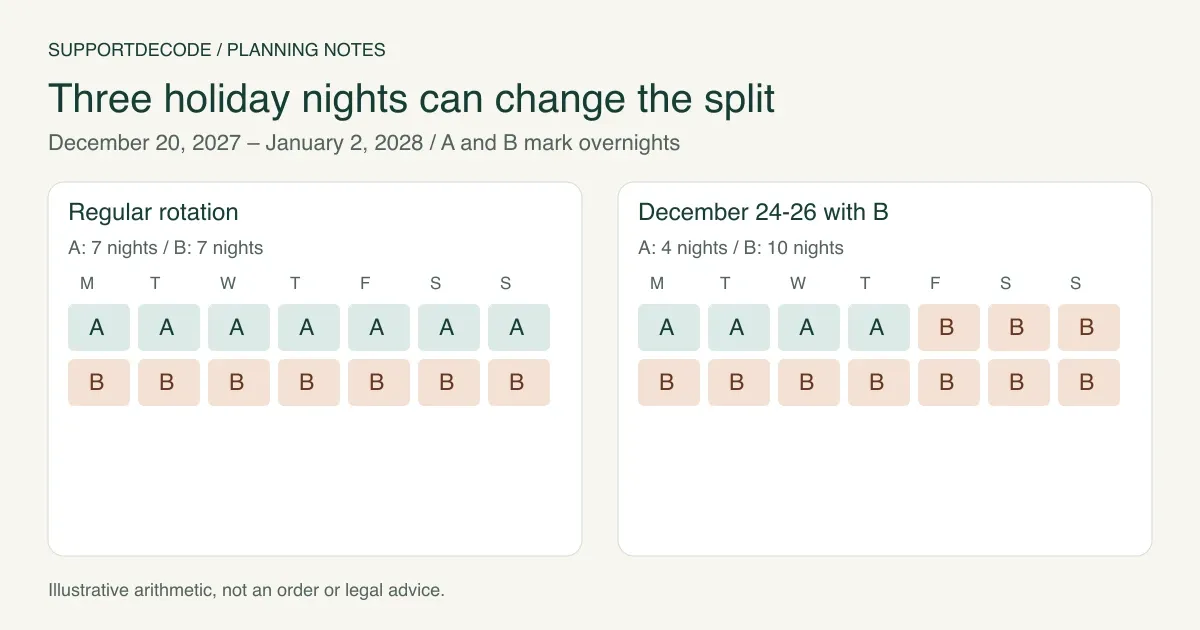
Regular rotation
Parent A: 7 nights. Parent B: 7 nights.
| Mon | Tue | Wed | Thu | Fri | Sat | Sun |
|---|---|---|---|---|---|---|
| A | A | A | A | A | A | A |
| B | B | B | B | B | B | B |
December 24–26 with B
Parent A: 4 nights. Parent B: 10 nights.
| Mon | Tue | Wed | Thu | Fri | Sat | Sun |
|---|---|---|---|---|---|---|
| A | A | A | A | B | B | B |
| B | B | B | B | B | B | B |
The original calendar has 7 A nights and 7 B nights. The revised calendar has 4 A nights and 10 B nights, or about 28.6% and 71.4% within this 14-night range. All three exception nights previously belonged to A, so three nights move from A to B.
The exception also joins B’s regular week, creating 10 consecutive B nights from December 24 through January 2. Counting only the holiday’s three nights would miss that longer stay. These are counts for the illustrated period, not annual custody percentages or a child support result.
An exception does not always move every night
Suppose instead that the exception is December 26–28 with B. December 27 and 28 already belong to B under the regular rotation. Only December 26 changes parent. The result would be 6 A nights and 8 B nights, not 4 and 10.
This is why adding “three extra nights” to one parent’s total can double-count. Compare the assignment on each date before and after the change. A night belongs to one parent in this overnight model; it cannot be added to B without checking whether it must be removed from A.
Does the regular rotation restart afterward?
In this tool, no. December 27 remains B’s night because the original rotation assigns it to B. The exception does not create a new day one or shift every later weekend.
A parenting plan may contain different return-to-schedule provisions. If your plan requires a restart or another arrangement, this override convention is not enough to model it automatically. Do not treat the export as a legal interpretation. Resolve the starting point and return rule before relying on the calendar.
For planning context, Kent County’s official resource asks parents to consider school breaks, transportation, work schedules, and safety. It also explains the value of specific days and exchange times. That is Michigan county guidance, not a national holiday-priority rule.
Recreate and check the example
- Open the custody calendar generator and choose alternating weeks with A first.
- Use exact dates: December 20, 2027, through January 2, 2028. The end date is the last included night, not the morning of return.
- Check the base calendar’s seven nights each, then add a B exception for December 24 through December 26.
- Confirm four A nights and ten B nights. Look at the dates immediately before and after the exception.
- Print the monthly calendar or download the calendar file after resolving any warnings.
An overlapping exception is refused rather than silently picking a winner. If a vacation and a holiday cover the same night, decide the intended assignment from the governing plan and enter non-overlapping ranges. This validation rule prevents conflicting data; it does not determine whose legal priority wins.
Check export dates and exchange times separately
Calendar downloads use all-day entries. An event covering the night of January 2 ends at the January 3 boundary in the file. That exclusive end date does not add another overnight. It is also not an instruction to exchange the child at midnight.
The tool does not supply pickup times, locations, travel consent, or make-up time. Keep those details in the governing plan and review the imported calendar’s first and last dates in your calendar app. A downloaded file is a snapshot, not a live subscription that updates the other household automatically.
For named-date planning templates, use the holiday schedule builder. For a seasonal change rather than a short exception, see the school-year versus summer comparison. To understand why a repeating 50/50 label can differ from a dated year, read how many overnights are 50/50.