“We agreed on 50/50” is where most custody conversations start, and it settles less than parents expect. Equal time is a math statement, not a schedule. Seven nights out of fourteen can mean the children switch houses six times in two weeks or just once, and those are very different childhoods.
This post shows what equal custody looks like in practice: what the term legally covers, the three calendars families actually use, and the numbers courts care about when they check whether a plan is really 50/50.
What does 50/50 custody mean?
Two separate things get called custody, and splitting one has nothing to do with splitting the other:
- Legal custody is decision-making power: education, medical care, religion. Most courts award joint legal custody even when parenting time is very unequal.
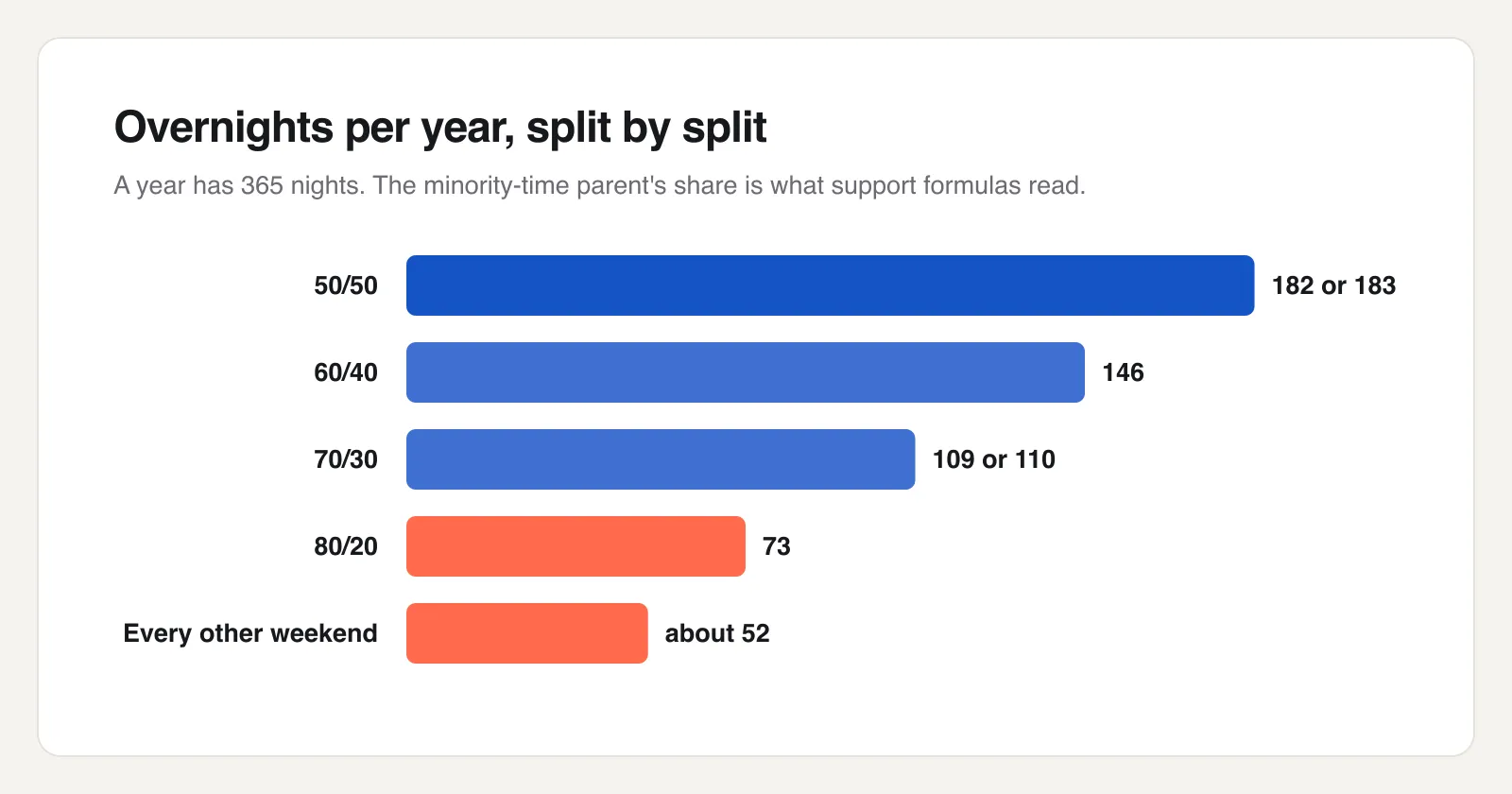
- Physical custody is where the children sleep. This is the half people mean by 50/50: overnights divided equally, 182 or 183 nights a year with each parent.
So a parent can share legal custody fully while having the children every other weekend, and two parents with a true 50/50 physical split still need a joint-legal arrangement on paper. When a court order says time is shared equally, the schedule attached to the order is what makes it real.
Is joint custody the same as 50/50?
No, and the two get mixed up constantly. Joint custody means both parents hold custody rights, usually joint legal custody and some meaningful parenting time for each. It says nothing about the split being equal. Plenty of joint-custody orders run 70/30 or 60/40. A 50/50 arrangement is one specific version of joint physical custody where the overnight count comes out even.
If your court paperwork says “joint physical custody,” look at the attached schedule, not the label, to know what your split actually is.
The three schedules parents actually use
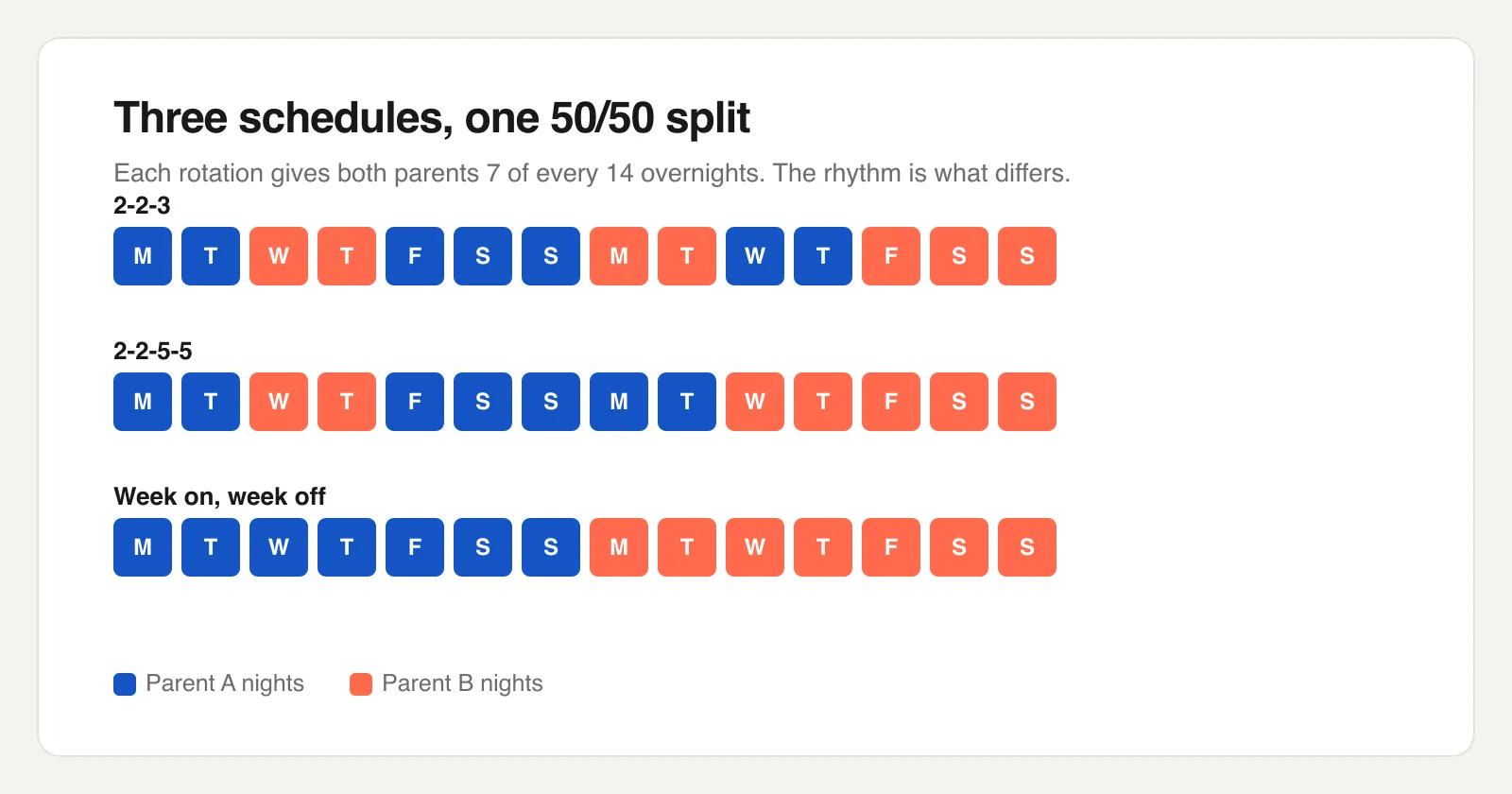
Any calendar that lands on 7 of every 14 overnights qualifies, but in practice mediators and courts propose the same three rotations again and again. The featured image above shows all three across one two-week cycle.
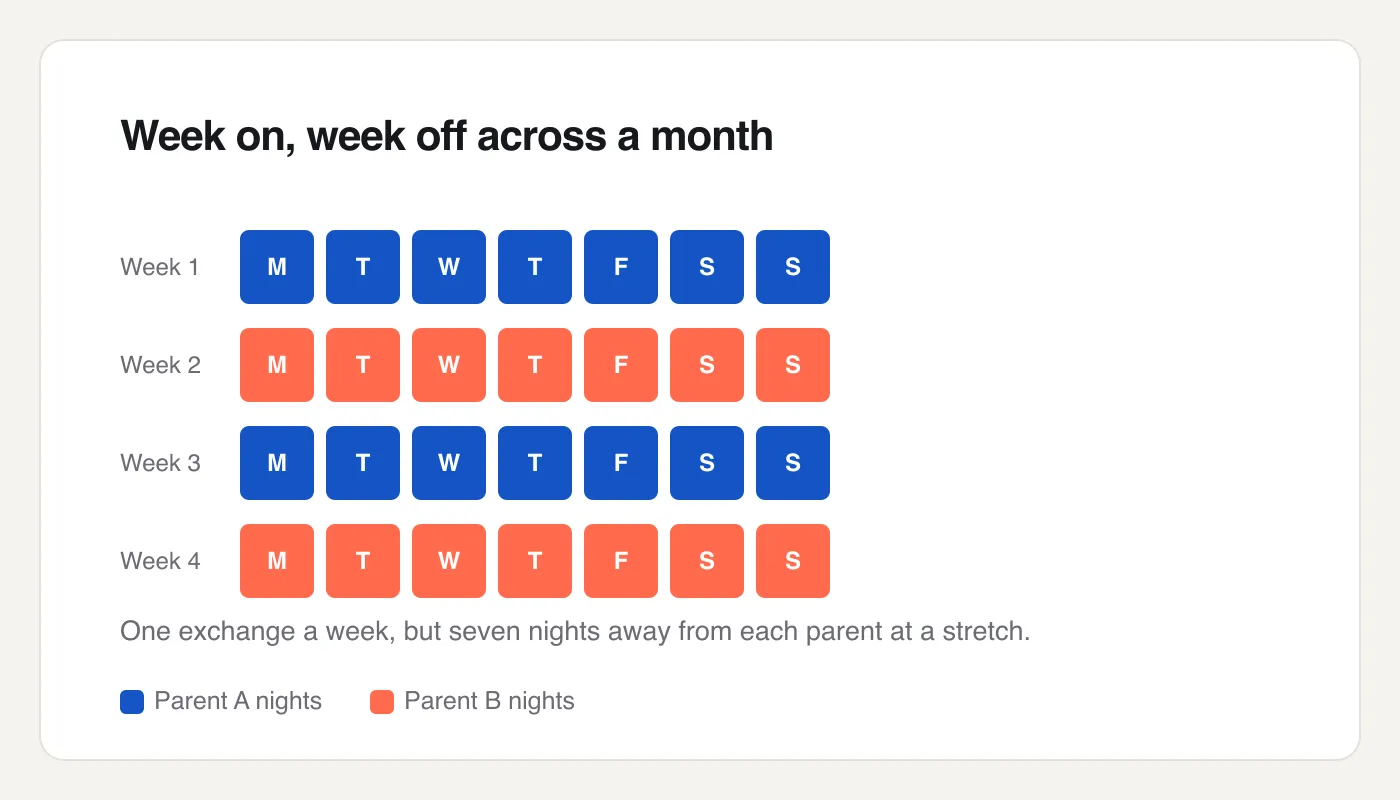
Alternating weeks (week on, week off). The simplest: seven nights with one parent, then seven with the other. One exchange a week, often Sunday evening or Monday at school.
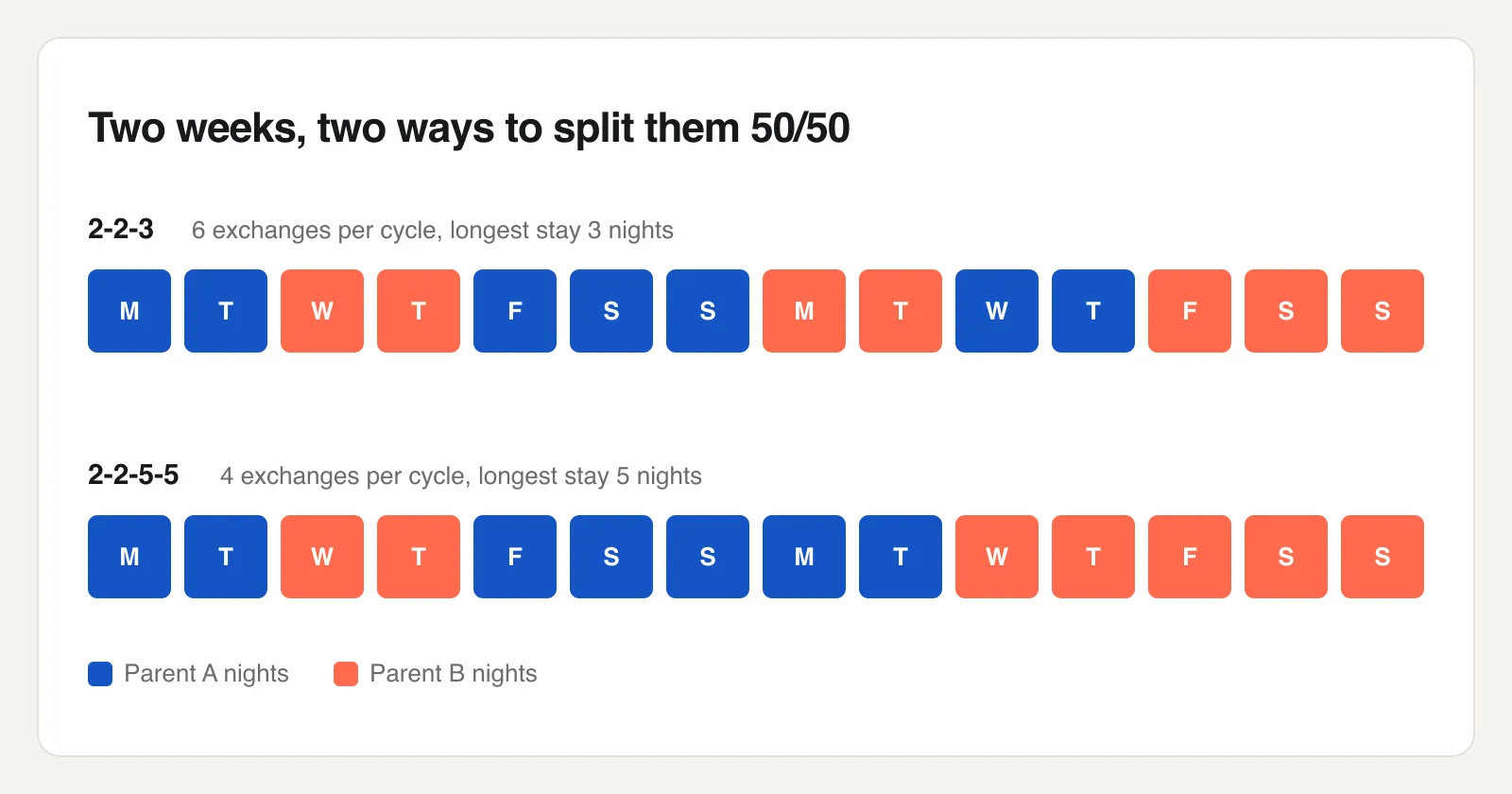
The 2-2-3. Two nights with parent A, two with parent B, then a three-day weekend that alternates. Nobody goes more than three nights without seeing the children, at the cost of six exchanges per cycle. The full breakdown is in the 2-2-3 vs 2-2-5-5 comparison.
The 2-2-5-5. Each parent keeps the same two weekdays every week and the weekend alternates, creating five-day blocks. Four exchanges per cycle and a school week that never changes shape. The visual guide to the 2-2-5-5 shows it across a full month.
Here is how the three compare on the numbers that shape daily life:
| Schedule | Exchanges per cycle | Longest stay | Longest gap from a parent |
|---|---|---|---|
| Alternating weeks | 2 | 7 nights | 7 nights |
| 2-2-3 | 6 | 3 nights | 3 nights |
| 2-2-5-5 | 4 | 5 nights | 5 nights |
How does 50/50 custody work day to day?
The calendar is half the arrangement; logistics are the other half. Families who make equal custody work tend to converge on the same habits:
- Two real homes, not a home and a visit. Each house keeps its own basics: toothbrushes, chargers, a core wardrobe, school supplies. The less that travels, the fewer meltdowns at handoff.
- School as the neutral exchange point. Drop-off by one parent and pickup by the other turns an exchange into a normal school day. The rotations above are usually tuned so most handoffs land on school days.
- A shared calendar both households can edit. Practices, appointments, and holidays live in one place. Most families run a shared phone calendar; a printable one from a schedule generator works for the fridge.
- Distance discipline. Equal splits strain past roughly a 20 to 30 minute drive between homes, because every school morning starts from both addresses. Long-distance 50/50 usually shifts toward week-based blocks to cut trips.
What counts as 50/50 in the eyes of a court?
Courts count overnights, not hours. A year has 365 nights, so a true equal split is 182 or 183 nights per parent; a written plan usually alternates the extra night by year. States that adjust child support for parenting time set thresholds along this scale, and several treat schedules well short of equal as shared custody for formula purposes. That is why a plan advertised as 50/50 that actually delivers, say, 160 overnights can carry real financial consequences: the count, not the label, feeds the formula.
Before signing anything, count the real overnights your proposed calendar produces. The parenting time calculator does it from any schedule, and the guide on how to read a custody schedule shows where advertised and delivered splits quietly diverge.
Does 50/50 custody mean no child support?
Usually not, and this surprises more parents than anything else on this page. Equal time equalizes the nights; it does not equalize the incomes. Most state formulas offset the two parents’ obligations, so when earnings differ, the higher earner typically still pays support. The full answer, with a worked example and the state-by-state thresholds, is in the guide on 50/50 custody and child support.
Questions parents ask
What is considered 50/50 custody?
An arrangement where each parent has the children for an equal share of overnights, 182 or 183 per year. Courts measure the schedule's actual overnight count, not the label the plan uses.
Is joint custody 50/50 by definition?
No. Joint custody means both parents hold custody rights; the time split can still be 60/40, 70/30, or anything the order sets. A 50/50 split is one specific form of joint physical custody.
How many overnights is 50/50 custody?
About 182 to 183 overnights per parent per year, which is 7 of every 14 nights. The odd night out of 365 is usually alternated between the parents year by year.
Is 50/50 custody right for every family?
No single schedule is. Courts decide custody on best-interest factors, and the practical fit depends on the children's ages, the distance between homes, and both parents' work patterns. The three rotations above exist because different families need different rhythms.