A summer custody schedule can keep the school-year rotation, replace it for a defined period, or add specific vacation exceptions. Those choices produce different calendars. School closing does not, by itself, tell this tool which arrangement applies. Start with the actual parenting plan and the school’s published dates.
Our summer custody planning page covers the choices and details to record. This comparison does something narrower: it counts two different rotations over the same 28 dates, then examines the boundary between them. The dates and arrangements are hypothetical, not a district calendar or a recommendation for your family.
Compare June 7 through July 4, 2027
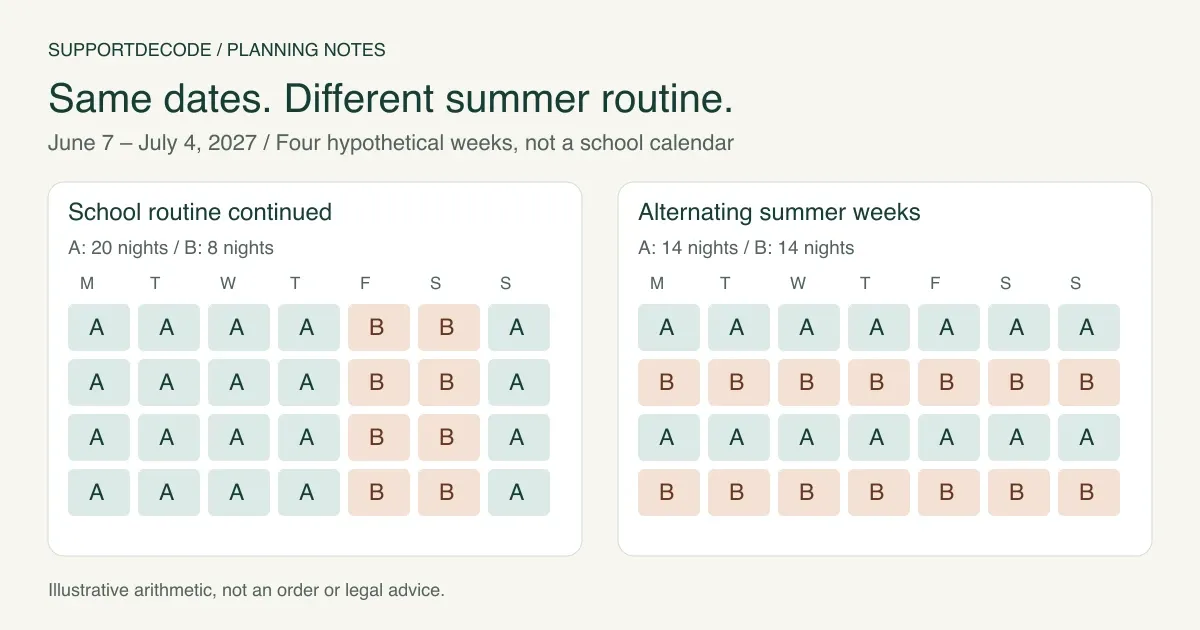
In the first version, Parent A keeps Monday through Thursday and Sunday nights. Parent B has Friday and Saturday nights. Continuing that school-week routine for four weeks gives A 20 nights and B 8 nights.
In the second version, A has the first full week, B the second, and the pattern repeats. Alternating weeks over the same dates gives 14 nights each. Each calendar below begins on Monday, June 7, and includes the night of Sunday, July 4.
School routine continued
Parent A: 20 nights. Parent B: 8 nights.
| Mon | Tue | Wed | Thu | Fri | Sat | Sun |
|---|---|---|---|---|---|---|
| A | A | A | A | B | B | A |
| A | A | A | A | B | B | A |
| A | A | A | A | B | B | A |
| A | A | A | A | B | B | A |
Alternating summer weeks
Parent A: 14 nights. Parent B: 14 nights.
| Mon | Tue | Wed | Thu | Fri | Sat | Sun |
|---|---|---|---|---|---|---|
| A | A | A | A | A | A | A |
| B | B | B | B | B | B | B |
| A | A | A | A | A | A | A |
| B | B | B | B | B | B | B |
The comparison changes the distribution from about 71.4%/28.6% to 50%/50% for those four weeks. B has six more overnights, but those six nights come from A’s original total. They are not extra dates added to the year.
This school-week example is not a prescription that one parent should always have school nights or the other should always have weekends. It is a deliberately different starting point that makes the effect of a seasonal change visible.
What happens when you combine the periods?
Extend the example backward by four weeks. Assume May 10 through June 6 uses the same school-week routine, giving A 20 nights and B 8. Combine that with the 14/14 summer example and the full 56-night period has A 34 nights and B 22 nights, about 60.7%/39.3%.
If the school-week routine instead continues for all 56 nights, the totals are 40 and 16. This comparison shows a six-night shift over a fixed window, not an annual custody calculation. The rest of the year, holidays, and other exceptions still need to be counted. A simple average of two percentage labels also fails when the periods have different lengths.
Use the parenting time calculator to count the actual range you need. Do not infer a support amount, tax entitlement, or custody classification from these percentages.
Check the first and last nights, not just the summer label
In the alternating-week example, B has June 28 through July 4. If the original school routine resumes on Monday, July 5, A takes that next night. That produces a clean boundary in this particular example. A different end date or starting parent could join two stays into a much longer block.
Before exporting, record:
- The final night under the school-year arrangement and first night under the summer arrangement.
- The summer’s last included night and the date the regular rotation resumes.
- Whether the original rotation continues in the background or is restarted under the plan.
- Pickup time, place, and who handles transport, including camp and childcare pickups.
- How any holiday or vacation within that period is resolved under the plan.
These are questions to settle, not universal legal defaults. Kent County’s parenting resource identifies school schedules, breaks, work, transportation, and safety as planning considerations. It is a Michigan county resource; it does not establish summer rules for all states.
Build a comparison without silently changing the year
Open the custody calendar generator twice and use the same exact start and end dates. Generate the every-weekend pattern in one version and alternating weeks in the other. Compare pickup responsibilities and the longest stays alongside the totals.
The generator supports one repeating base rotation plus dated exceptions. It does not automatically switch to a second repeating rotation for an entire season. For a full-year model, keep the base year’s anchor and enter the agreed summer blocks as non-overlapping exceptions, checking every date, or make separate calendars for explicitly bounded periods. There is a limit of 24 exception ranges. Never restart the base calendar on a different date and assume the prior weekday assignments remain unchanged.
For a short vacation rather than a seasonal rotation, the holiday exception worked example shows how replacement nights affect the total and why overlapping exceptions are rejected.
Choose based on logistics, not a promised best schedule
Equal totals do not make two routines equally practical. Compare the adult available during work hours, camp registration dates, travel distance, activities, and supplies that must move between homes. Include the child’s needs and safety rather than choosing a rotation because its percentage looks tidy.
There is no age-based recommendation or automatic summer entitlement in this comparison. If your existing order is unclear, or communication is unsafe, obtain case-specific help before changing the plan. Printing a calendar is useful for reviewing dates; it does not change an order.