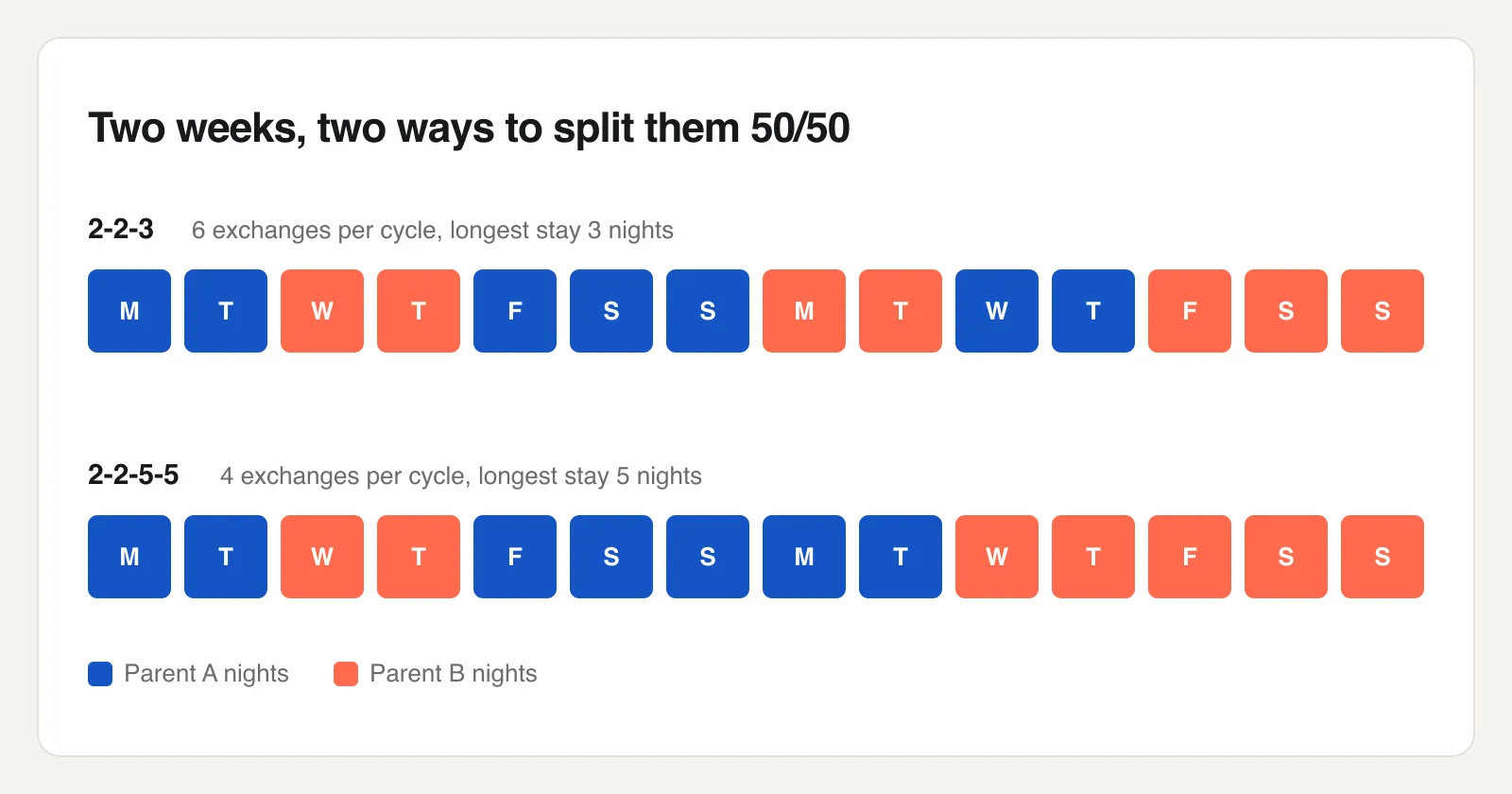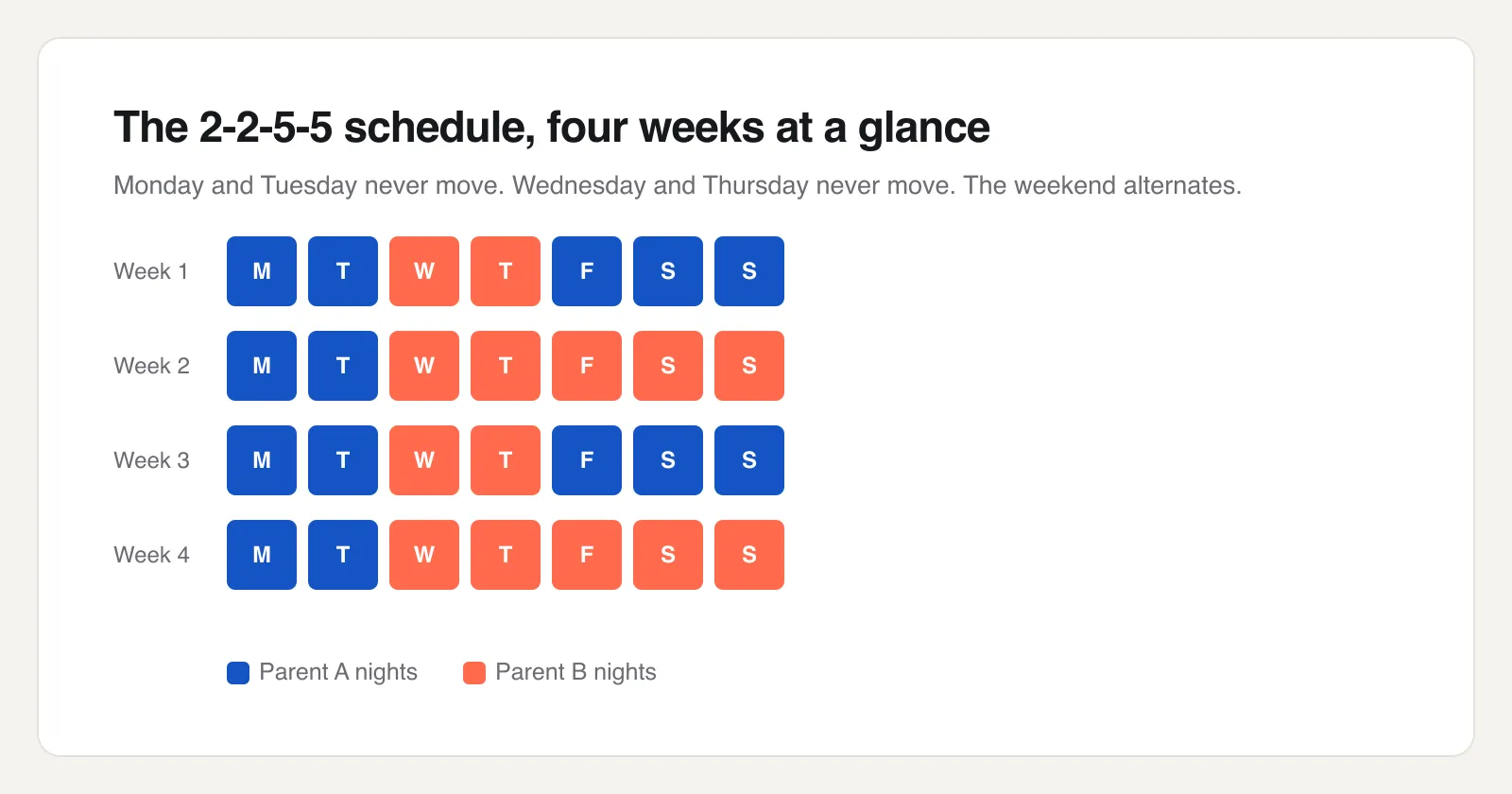

A 2-2-5-5 schedule and a week-on, week-off schedule both give each parent 7 of every 14 overnights. The difference is the routine. In a Monday-start 2-2-5-5, each parent keeps the same two weekdays and weekends alternate. Alternating weeks gives each parent a full seven-night block, with fewer exchanges but longer gaps between stays.
Neither is automatically better. Compare the actual school runs, time between stays, and holiday exceptions before choosing a label. These are planning examples, not a recommendation to change an existing order.
See both calendars side by side
Both examples below start on Monday with Parent A. The A and B labels matter more than the colors. Read the top row, then the bottom row, then return to the top.
2-2-5-5 schedule
| Mon | Tue | Wed | Thu | Fri | Sat | Sun |
|---|---|---|---|---|---|---|
| A | A | B | B | A | A | A |
| A | A | B | B | B | B | B |
Top row: week 1. Bottom row: week 2. Then repeat.
Week on / week off
| Mon | Tue | Wed | Thu | Fri | Sat | Sun |
|---|---|---|---|---|---|---|
| A | A | A | A | A | A | A |
| B | B | B | B | B | B | B |
Top row: week 1. Bottom row: week 2. Then repeat.
In the 2-2-5-5 example, Parent A has Monday and Tuesday every week. Parent B has Wednesday and Thursday. Friday through Sunday alternates. Parent A’s first weekend joins the next Monday and Tuesday to make a five-night stay.
In the alternating-weeks example, one parent has all seven nights of week 1 and the other has week 2. Monday is only this illustration’s starting point. Your real plan must say when and where the weekly exchange happens.
Four exchanges versus two, with the boundary counted
| Measure | 2-2-5-5 | Week on, week off |
|---|---|---|
| Overnights | 7 each | 7 each |
| Exchanges per repeating cycle | 4 | 2 |
| Longest uninterrupted stay | 5 nights | 7 nights |
| Monday through Thursday | Same parent on each weekday | Changes parent each week |
| Weekends | Alternate | Alternate |
An exchange is a change from one parent’s overnight to the other’s. Count the change from the last night back to the first night of the next cycle too. Looking only inside the two rows gives three changes for 2-2-5-5 and one for alternating weeks; that misses the boundary exchange.
These are overnight-calendar counts, not a promise about how many times parents meet. A school pickup can handle a change of care without a face-to-face handoff. An extra dinner visit can add travel without changing a single overnight.
The practical choice: fixed weekdays or fewer transitions?
Fixed weekdays can help with standing commitments. If one parent can handle every Tuesday practice, the 2-2-5-5 example assigns Tuesday to that same parent throughout the cycle. Check the other days too: consistency is only useful if both households can cover their assigned school runs and appointments.
Alternating weeks reduces overnight exchanges. It may simplify packing and give each household a complete school-week routine. But a recurring Wednesday appointment changes responsible parent each week, and a seven-night stay means seven nights between the child’s stays at the other home.
A short comparison exercise is more useful than declaring either pattern the winner:
- Put the same two weeks of work shifts, school hours, and activities on each calendar.
- Mark the adult responsible for each pickup, including a backup if school closes.
- Identify supplies that must travel and items that can stay in both homes.
- Discuss how the child will keep contact with the other parent, if appropriate and safe.
- Mark any conflict the schedule creates. Do not assume the other household can absorb it.
Kent County’s official parenting resource similarly asks parents to consider school, work, transportation, development, and safety. It is Michigan county guidance, not a nationwide rule about which ages belong on which schedule. We do not label either rotation “best for age X.”
Does an extra midweek visit change 50/50?
A visit that ends before bedtime does not change the overnight assignments shown here. It can still add travel or a change of care, so write it on the calendar rather than hiding it behind the phrase “alternating weeks.”
An extra overnight is different. If Parent B takes one of Parent A’s seven nights and no night is exchanged back, the cycle becomes 6 nights for A and 8 for B. That is about 42.9% and 57.1%, not 50/50. Swapping an equivalent night back can restore the split, but the resulting pattern is no longer the untouched example above.
These percentages describe time only. They do not establish custody rights, tax eligibility, or a child support amount.
Holidays and calendar years need their own count
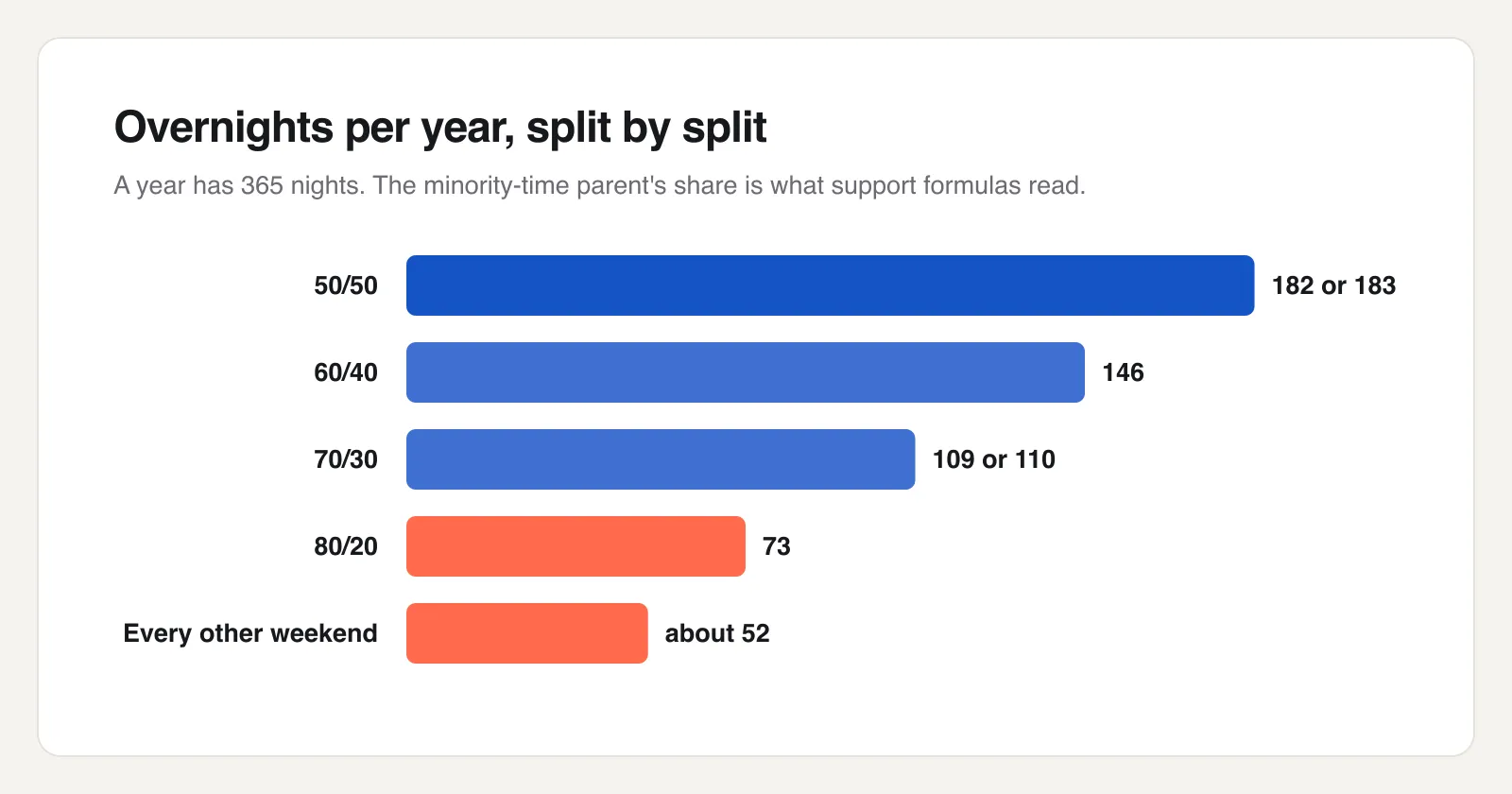
A repeating 14-night schedule is exactly even within each full cycle. A calendar year does not contain only complete 14-night cycles. For example, 365 days is 26 complete cycles plus one extra day. Starting position and holiday changes therefore matter when you count a particular year.
Do not enter “182.5 overnights” as though it were a record of where a child slept. Count the dates your worksheet or planning question actually uses. The parenting time calculator helps count a dated plan; your state’s support rules determine how that count is used.
Holiday overrides can also join two blocks into a longer stay than the base rotation suggests. Look at the nights immediately before and after a holiday, not just the holiday itself. Your existing order’s holiday provisions control; a sample calendar does not override them.
See the dated holiday exception comparison: three changed nights turn a 7/7 period into 4/10 without restarting the original rotation. For a longer seasonal change, the school-year versus summer example compares identical dates before combining periods.
Try both schedules before committing to either
Open the 2-2-5-5 calendar generator and the alternating-weeks calendar generator with the same starting date. Generate each separately, then compare school pickups, weekend plans, and the longest stay in your chosen date range. Download the calendar files to review in your calendar app, or print this comparison with your browser for a discussion copy.
Our 2-2-5-5 visual guide explains that pattern in more detail. If seven-night or five-night gaps are the concern, compare the shorter blocks in 2-2-3 versus 2-2-5-5 as well.
Questions parents ask
Is 2-2-5-5 the same as week on, week off?
No. Both examples divide a 14-night cycle equally, but 2-2-5-5 has fixed weekday assignments and four exchanges per repeating cycle. Alternating weeks has seven-night blocks and two exchanges.
Is 5-2-2-5 a different custody percentage?
The name can describe the same repeating rotation from a different starting point. Read the actual overnight assignments and exchange times. A label alone does not establish the calendar or its percentage.
Can a 50/50 rotation guarantee the same child support?
No. This comparison counts overnights only. A dated year, holidays, incomes, expenses, and the applicable state worksheet can affect the support calculation. A schedule label is not a support result.