Most 50/50 schedules look neat in a spreadsheet and confusing on a real fridge calendar. The 2-2-5-5 is the exception. Once you see its trick, you can hold the whole thing in your head: each parent owns the same two weekdays forever, and the weekend swings back and forth.
This guide shows the rotation visually, explains the 5-2-2-5 naming confusion, and counts the overnights and exchanges. Jump to the dated, printable calendar, or read the Monday-start example below.
What is a 2-2-5-5 custody schedule?
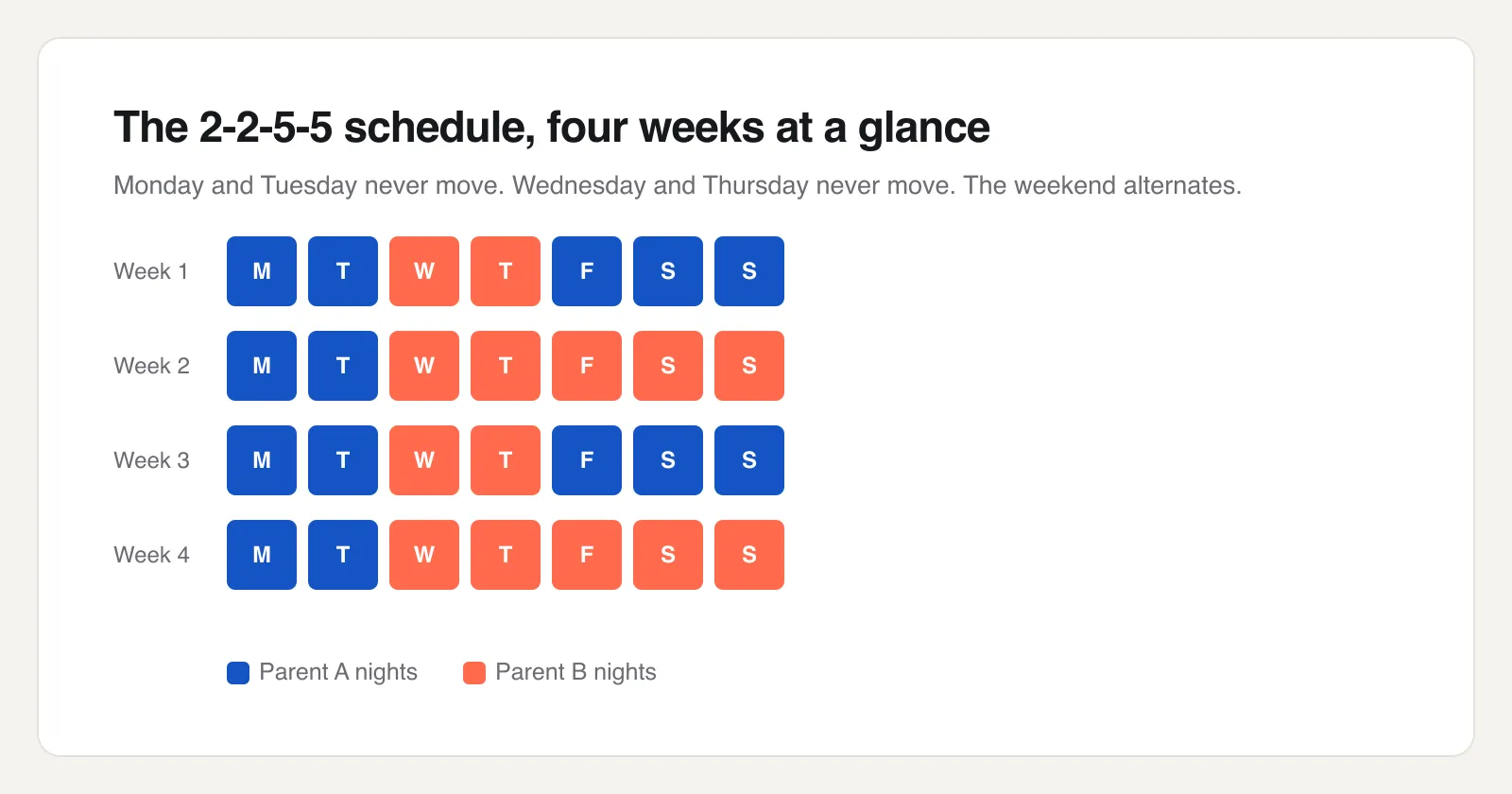
The 2-2-5-5 is a 14-day rotation that splits parenting time equally. Reading the numbers in order: parent A takes 2 days, parent B takes 2 days, then parent A takes 5 days, then parent B takes 5 days. The cycle closes at exactly two weeks and repeats.
Laid on a standard week starting Monday, it plays out like this:
- Monday and Tuesday: parent A, every single week
- Wednesday and Thursday: parent B, every single week
- Friday through Sunday: alternates between the parents
The five-day blocks come from the weekend joining the anchor days. When parent A has the weekend, Friday through Tuesday forms one five-night run. The next week, parent B’s Wednesday through Sunday does the same.
The anchor days are the whole point
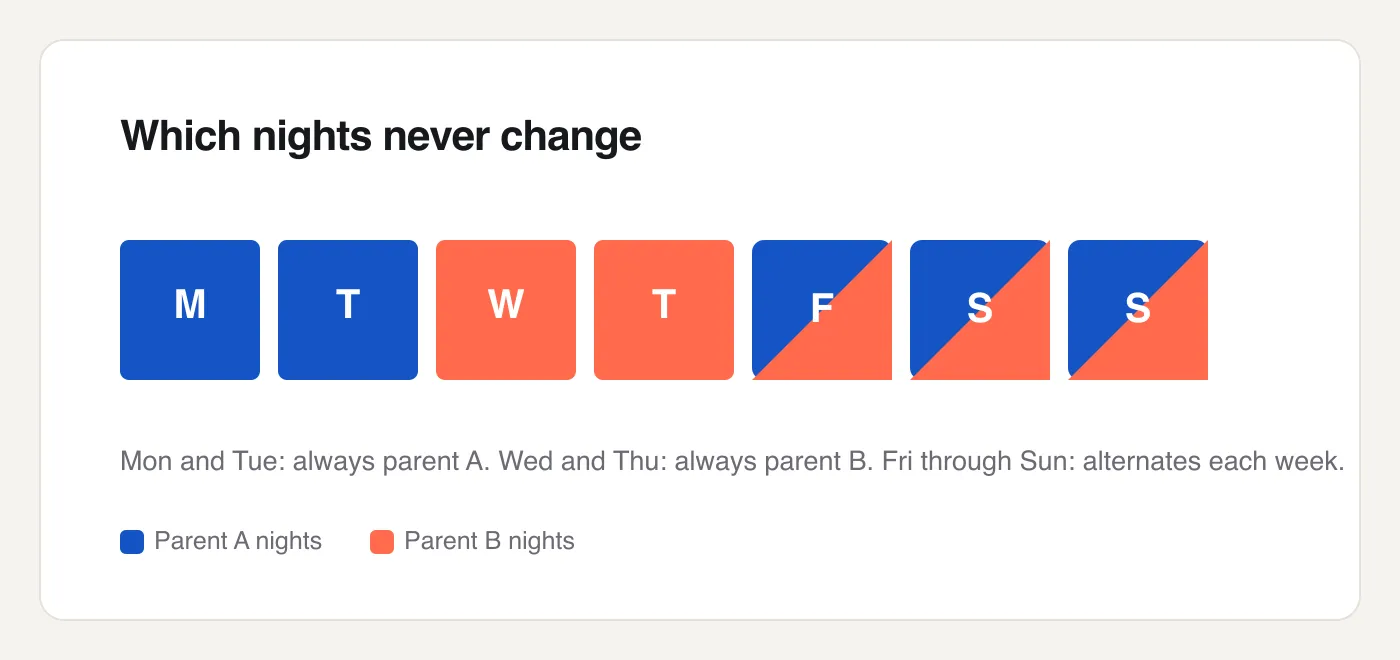
That fixed weekday structure is why families pick this rotation over other equal splits. Tuesday piano lessons always fall on the same house. Wednesday therapy appointments always fall on the other. Nobody has to check which week it is before signing a permission slip for a Thursday field trip.
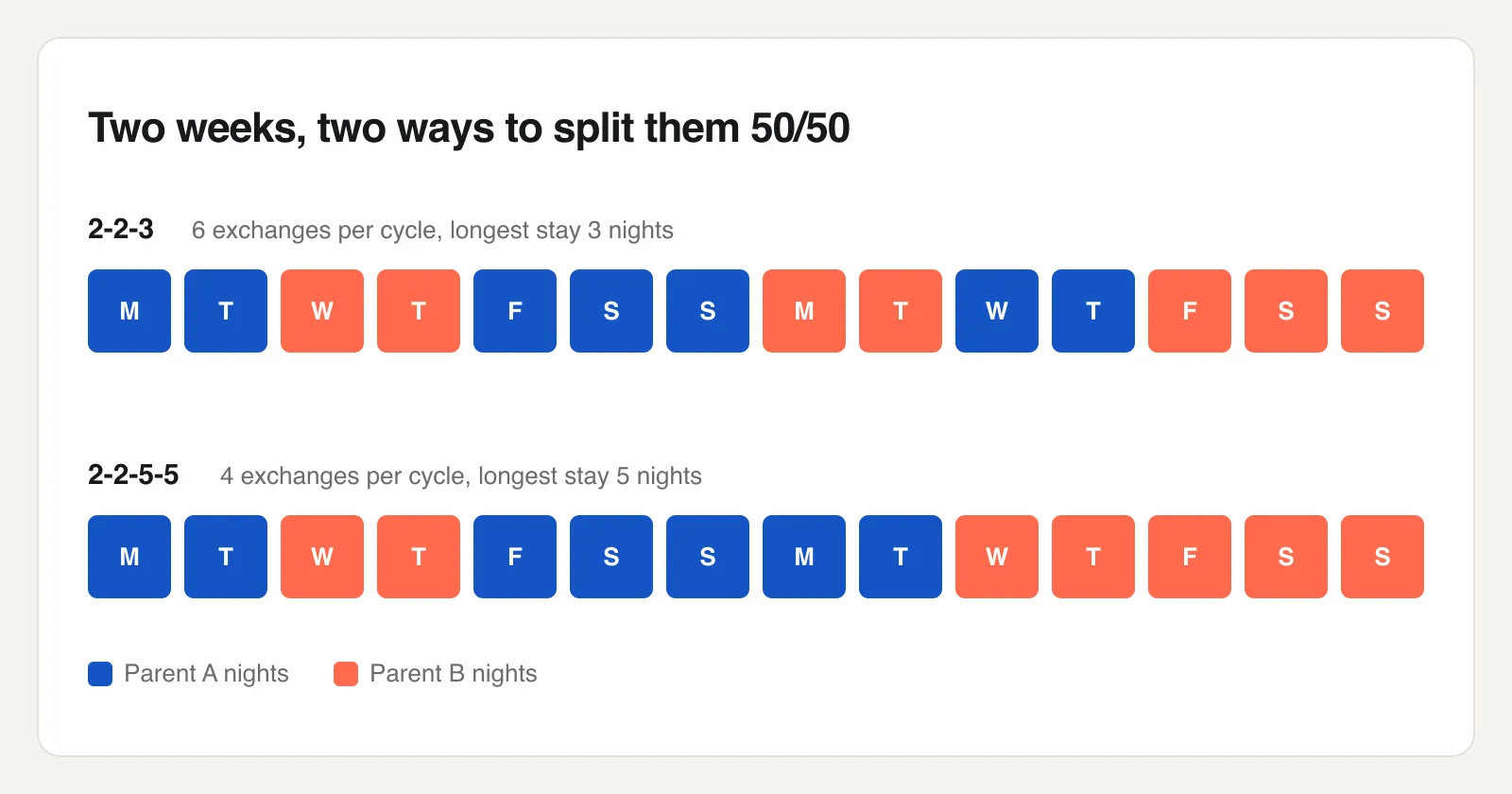
Compare that with a 2-2-3 rotation, where the weekday pattern flips every week and both parents cycle through every kind of school night. Flexible, but harder to routine around. If that trade-off is your actual decision, the 2-2-3 vs 2-2-5-5 comparison walks through it in detail.
2-2-5-5 or 5-2-2-5: same schedule, different starting point
You will see both names, plus 5-5-2-2 and 2-5-5-2, and they describe the same rotation. Some people drop the dashes and write 2255 or 5225. The numbers just start counting from a different day in the cycle. A 5-2-2-5 reads the pattern starting from one of the five-day blocks; a 2-2-5-5 starts from the two-day blocks. The calendar underneath is identical.
One nearby variant is genuinely different: some parenting plans write “2-2-5” to describe the first half of the rotation. In practice a repeating schedule needs the full 14-day cycle to balance, so a court order will usually spell out the whole 2-2-5-5 pattern with named weekdays rather than shorthand.
How many overnights does each parent get?
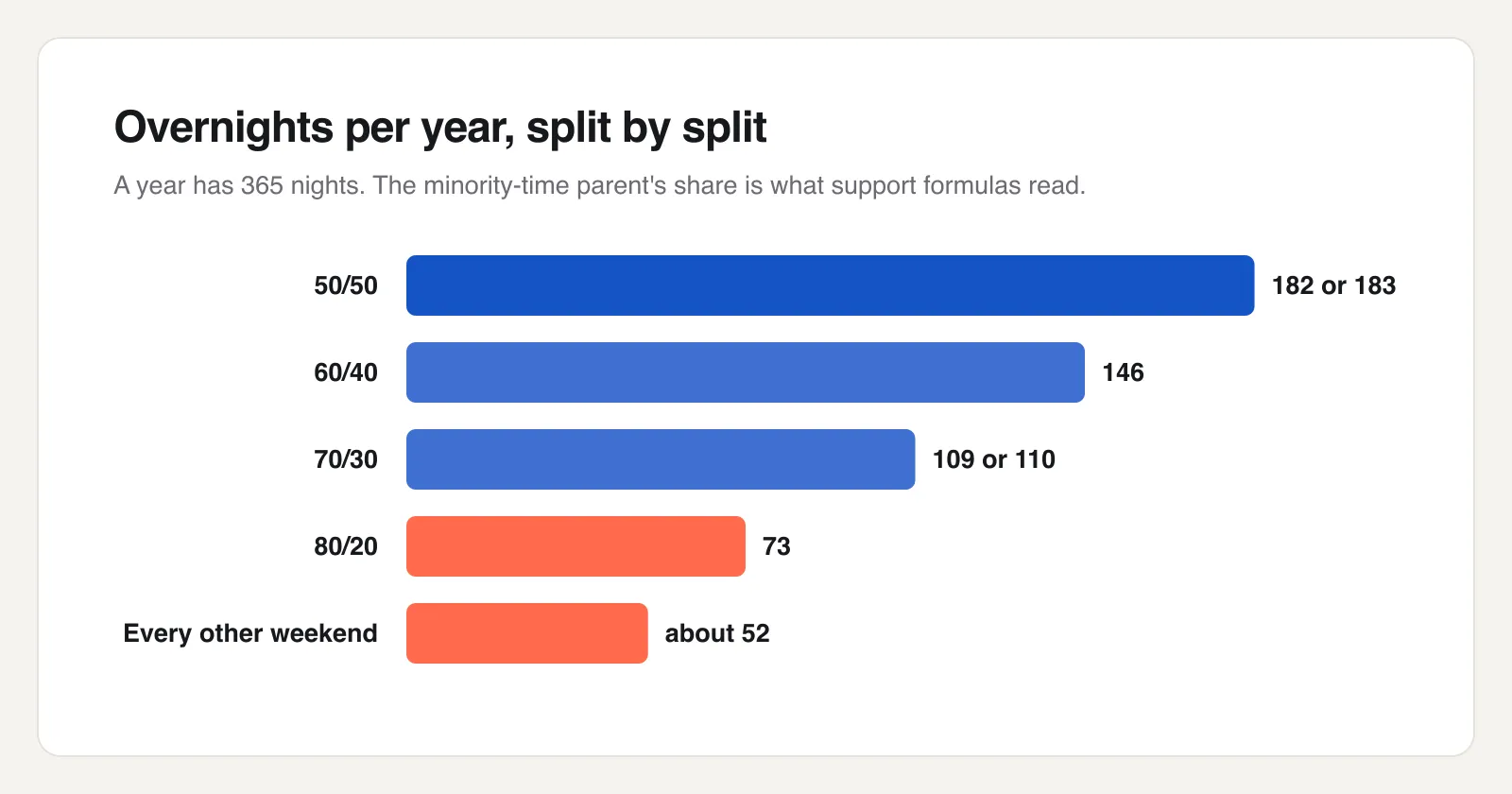
Seven of every fourteen, exactly. Over 365 nights, one parent has 182 and the other 183. A leap-year or court-defined range may produce different totals. Use the actual counting period and the official worksheet’s method, not an assumed 182.5 nights for each parent. Holidays and exceptions are not included in this repeating preview.
The longest overnight stay with one parent in this rotation is five nights. For comparison, a 2-2-3 has a three-night maximum, and week-on-week-off has seven. Those are calendar counts, not recommendations for a child’s age or needs.
Four exchanges every two weeks
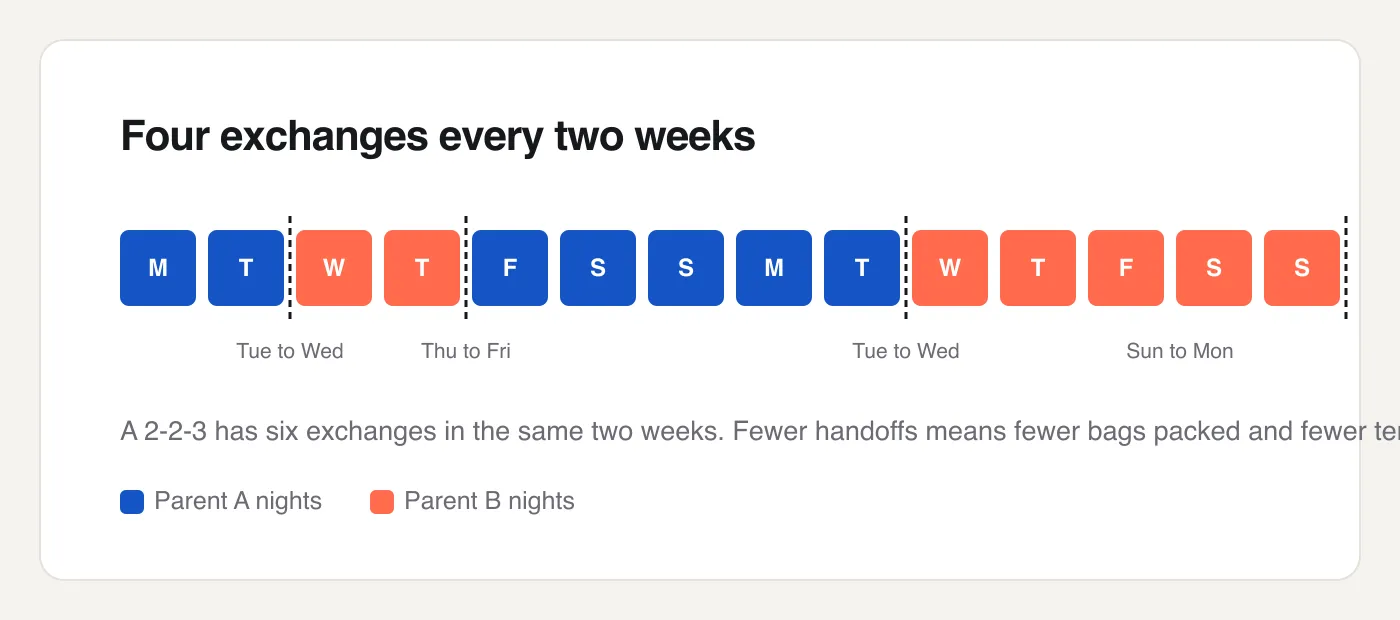
Two of the four handoffs can disappear into the school day: one parent drops the children at school, the other picks them up, and the exchange happens without the parents meeting at all. Families with longer drives between homes or tense handoffs often choose the 2-2-5-5 over a 2-2-3 for exactly this reason: six exchanges per cycle becomes four.
Practical questions before choosing a rotation
The fixed weekday pattern raises a few practical questions:
- Can each household cover its fixed weekdays alongside work and school?
- How would five-night stays work for this child’s particular needs?
- Which home would handle each recurring weekly activity?
- Are exchanges, travel and communication safe and workable?
There is no age rule built into this calendar. Safety concerns, existing orders and individual needs require more than a schedule comparison. Rotating work shifts can also make fixed weekdays impractical.
Does the 2-2-5-5 change child support?
The rotation’s name does not determine child support. States use different parenting-time definitions, income rules and expense adjustments. Equal time alone does not establish a zero payment. Use the state calculator’s supported inputs and official sources; this calendar does not make a legal custody or support determination.
Put it on a real calendar before you commit
Considering longer stays and fewer exchanges? See the 2-2-5-5 versus week-on, week-off calendar comparison for both two-week grids and a practical planning checklist.
A rotation that reads well in this post can still collide with your actual life: a standing Thursday shift, a long commute, a child’s Friday practice. Test it on real dates first. The custody schedule generator lays the 2-2-5-5 onto a live calendar from any start date and exports it as a calendar file for both phones. The Monday-start calendar template labels the cycle night by night, and the parenting time calculator confirms the exact overnight percentage for court paperwork.
Questions parents ask
What is a 5-2-2-5 schedule custody arrangement?
The same rotation as the 2-2-5-5, counted from a different starting day. Both names describe a 14-day cycle where each parent keeps two fixed weekdays and the parents alternate five-day blocks across the weekend.
Can I print a 2-2-5-5 calendar?
Yes. Choose a start date and first parent in the preview, then select Print this calendar. The print view includes the first 14 nights and the 365-night count, without the rest of the article. Use the full generator for a calendar-file export.
How many nights in a row is the longest stay?
Five nights. Each parent gets one five-night block per two-week cycle, formed by their two anchor weekdays joining their alternating weekend.
Does 2-2-5-5 work for toddlers?
A calendar cannot decide that. The longest stay in this rotation is five nights. A child’s needs, safety and existing orders matter; this page makes no age-based custody recommendation.