On a calendar, 70/30 can mean an exact ten-day loop of seven nights and three nights, or a weekly plan with the minority-time parent keeping two nights every weekend. The first hits the ratio exactly but drifts across weekdays. The second stays fixed to the school week but lands closer to 71/29. This article compares those two calendars rather than treating the rounded label as one universal rotation.
The exact version: a 10-day cycle
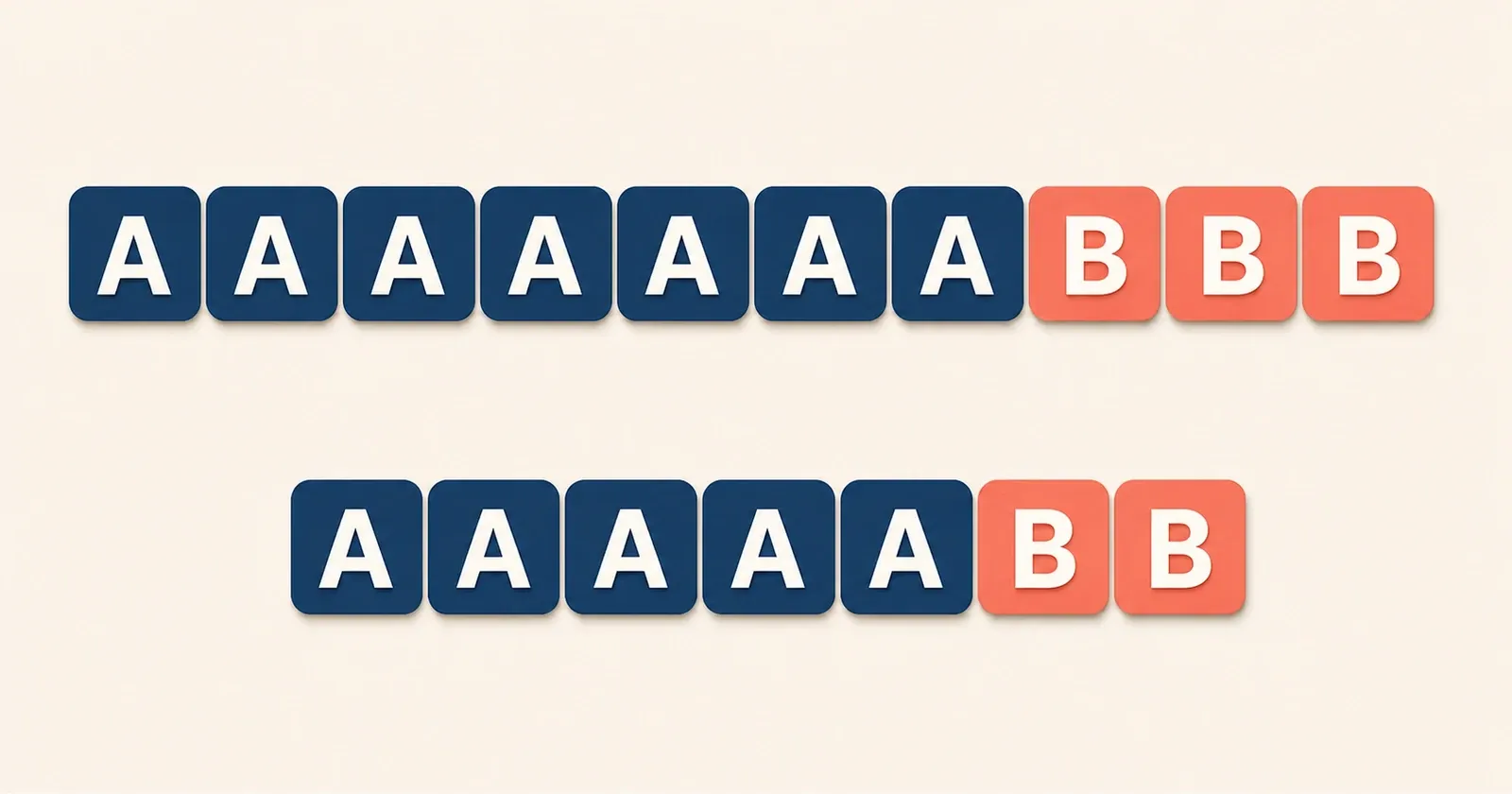
The mathematically clean 70/30 is a repeating ten-day cycle: seven nights with parent A, then three with parent B. Ten days divides 70/30 perfectly, and over a year parent B collects about 110 overnights.
The catch is that ten days does not divide into seven. The cycle drifts across the week, so parent B’s three-night block lands on Tuesday one round, Friday the next, then Monday. Parents with fixed work schedules and children with fixed school schedules usually find the drift unworkable within a few cycles. It suits the opposite situation: shift workers, travel-heavy jobs, or families where weekday-versus-weekend distinctions matter less than the block lengths.
The weekly version: every weekend
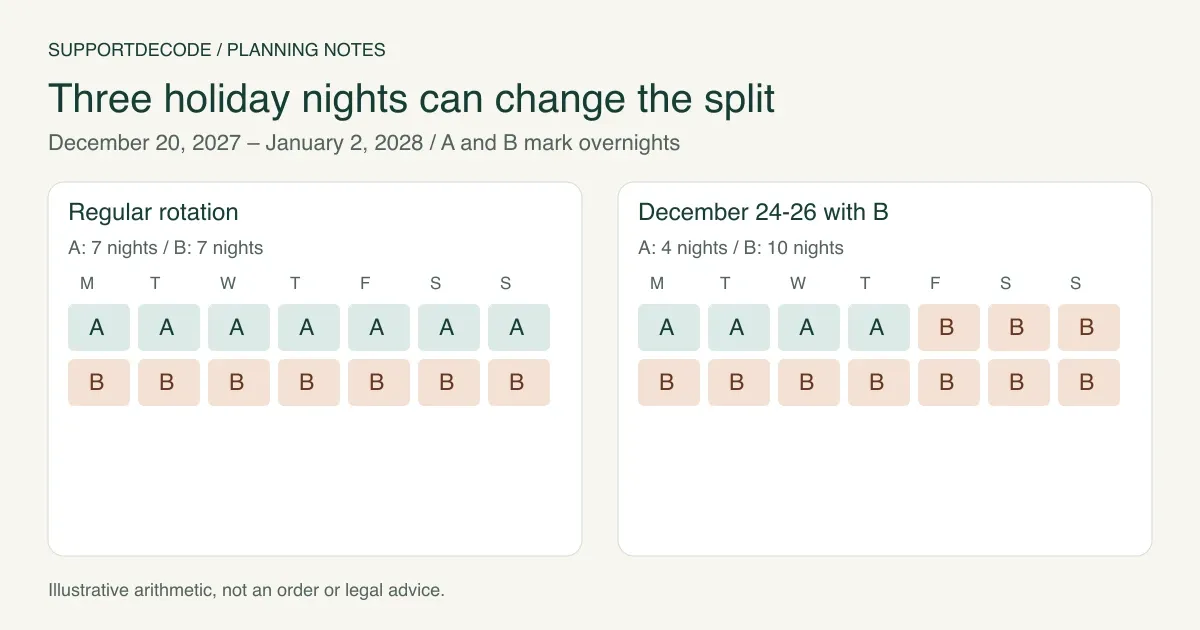
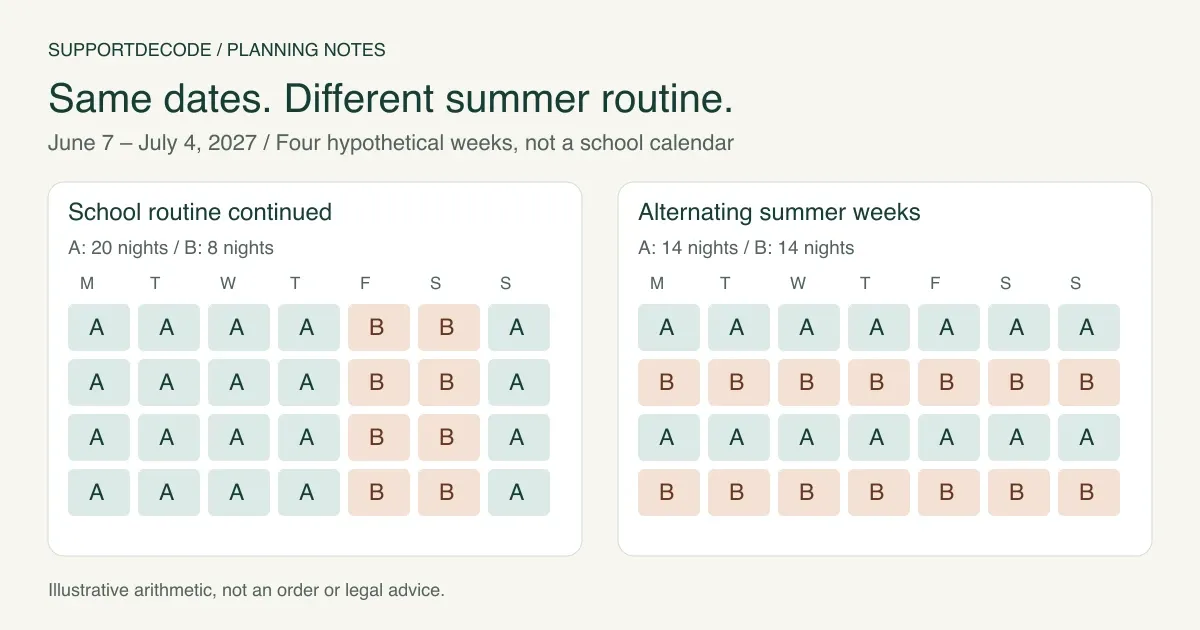
The version that survives contact with a school calendar runs on a plain week: parent B has every Friday-to-Sunday weekend, parent A has every school night. Three of seven nights is technically 43 percent, but families and lawyers commonly file this under 70/30 when the weekend is trimmed to two nights, Friday and Saturday, which lands at 104 overnights, almost exactly 30 percent.
That trimmed version is worth comparing against its neighbors:
| Arrangement | Nights per cycle | Overnights per year | Real split |
|---|---|---|---|
| Every weekend, 3 nights (Fri-Sun) | 3 of 7 | about 156 | 57/43 |
| Every weekend, 2 nights (Fri-Sat) | 2 of 7 | about 104 | 71/29 |
| Alternating 3-day weekends | 3 of 14 | about 78 | 79/21 |
| Alternating weekends plus a midweek overnight | 5 of 14 | about 130 | 64/36 |
The lesson in that table: the distance between “every weekend” and “every other weekend” is roughly doubling the child’s time with the minority parent. Which row a plan lands on is worth an explicit conversation, not an assumption.
70/30 or 80/20: the practical difference
An 80/20 arrangement, classically alternating three-day weekends, gives the minority-time parent about 73 to 78 overnights. Moving to 70/30 adds roughly 30 more nights a year, usually by making the weekends weekly instead of alternating or by adding a standing midweek overnight. Day to day, the difference is rhythm: under 70/30 the children see both parents every single week, while 80/20 has them away from one parent for stretches of eleven days. For young children especially, that gap is the argument families weigh most.
Does 70/30 custody change child support?
Whether roughly 110 overnights moves the support number depends entirely on the state. Some formulas scale continuously with every overnight, some switch methods at a threshold near this range, and a few ignore overnights altogether. The states that draw hard lines at 20 and 25 percent are mapped in the overnight conversion guide, and the offset mechanics are worked through in do you pay child support with 50/50 custody; at 70/30 the same machinery simply runs further from the midpoint.
See it on real dates
The 70/30 custody schedule page owns the exact ten-day cycle and walks it night by night. The custody schedule generator shows exactly where those blocks fall on this year’s calendar, drift and all, before you compare it with the fixed weekly version.
Questions parents ask
What is a 70/30 custody schedule in overnights?
About 109 or 110 overnights a year for the minority-time parent, which is 30 percent of 365. The common practical versions deliver between 104 and 130 depending on how the weekends and midweek nights are set.
What does 70/30 look like on a weekly calendar?
Most often: the children with parent A on school nights and with parent B every Friday and Saturday night, sometimes with Sunday or a midweek overnight added. The exact 10-day 7-and-3 rotation exists but drifts across weekdays.
Is 70/30 considered joint custody?
It can be. Joint custody describes shared rights and meaningful time with both parents, not a fixed ratio. Whether 110 overnights triggers shared-custody treatment in a support formula depends on the state threshold.