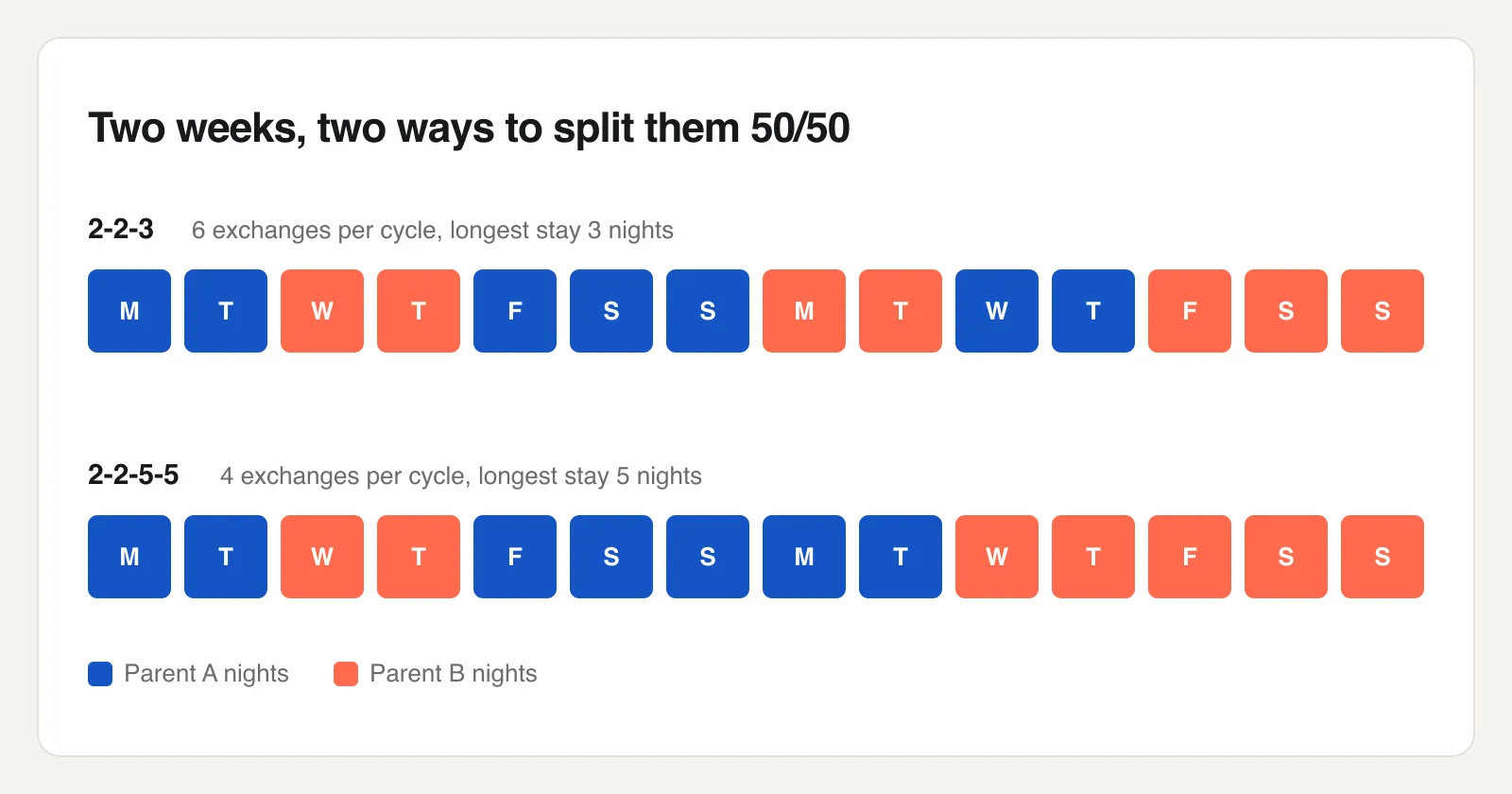
The 2-2-3 and the 2-2-5-5 are the two most common ways to share parenting time equally. Both give each parent 7 of every 14 overnights. Both repeat on a clean two-week cycle. On paper they look interchangeable, and that is exactly why so many parents pick the wrong one for their situation.
The difference is not the split. It is the rhythm: how often the kids change houses, how long each stay lasts, and whether a parent always has the same school nights. This post walks through both rotations, then shows how to test each one against your real calendar before anything goes in a parenting plan.
What the two names mean
Each number is a block of days, and the blocks alternate between parents.
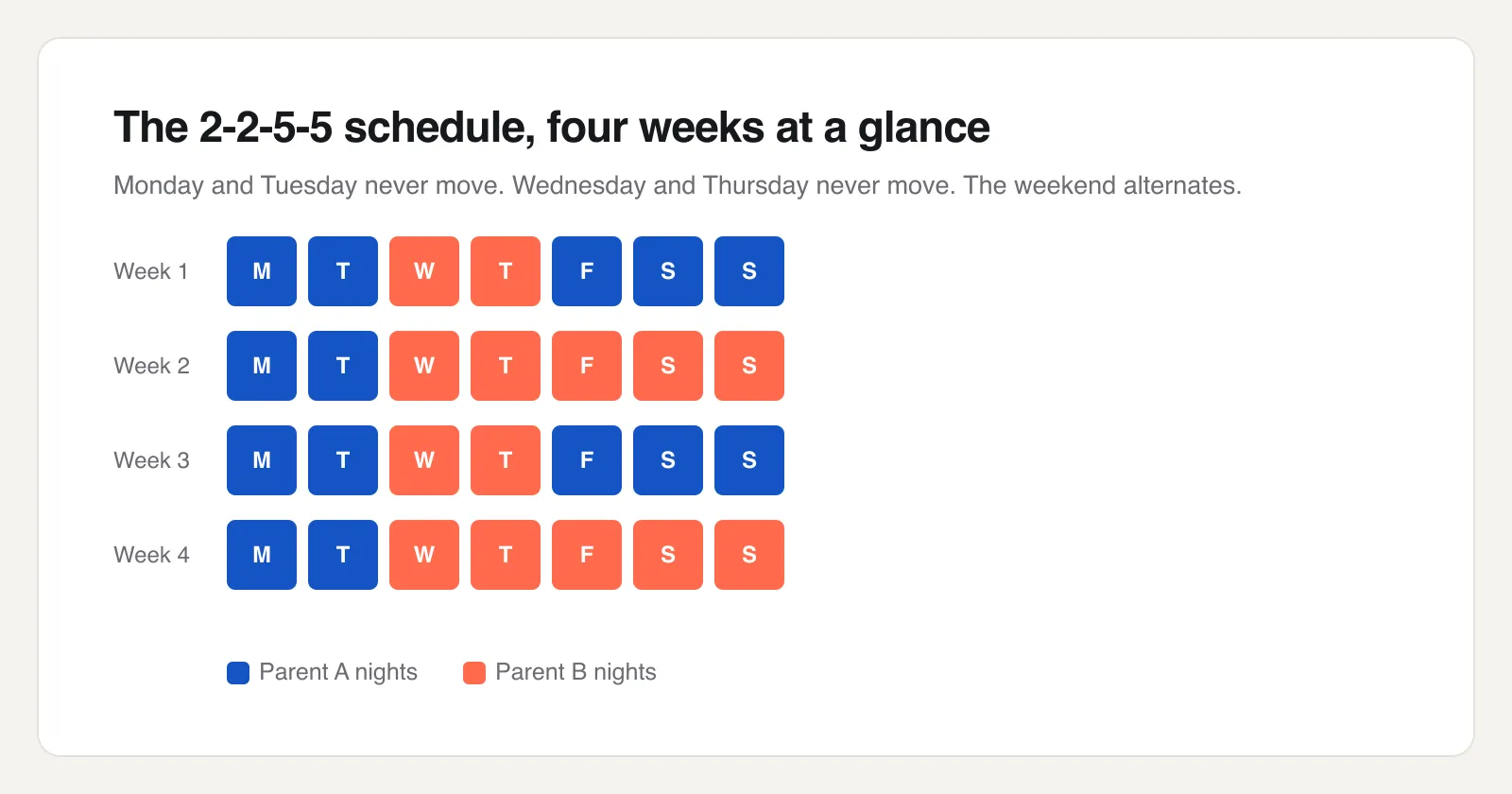
In a 2-2-3, parent A has Monday and Tuesday, parent B has Wednesday and Thursday, and parent A takes the three-day weekend. The next week the roles flip. Nobody waits more than three nights to see the kids again.
In a 2-2-5-5, the week starts the same way: parent A has Monday and Tuesday, parent B has Wednesday and Thursday. Then the blocks stretch. Parent A takes a five-day run from Friday through the next Tuesday, and parent B takes the following five days. The cycle still closes at 14 days.
The same split, a different rhythm
| What changes | 2-2-3 | 2-2-5-5 |
|---|---|---|
| Overnights per cycle | 7 and 7 | 7 and 7 |
| Exchanges per cycle | 6 | 4 |
| Longest stay | 3 nights | 5 nights |
| Longest gap away from one parent | 3 nights | 5 nights |
| Weekday pattern | Flips every week | Same school nights every week |
That last row is the one families feel day to day. In a 2-2-5-5, parent A always has Monday and Tuesday nights and parent B always has Wednesday and Thursday nights. Homework routines, practice schedules, and school pickups land on the same person every single week. In a 2-2-3, the weekday pattern flips each week, so both parents share every kind of school night over time.
Where 2-2-3 shines
Short gaps are the whole point of a 2-2-3. A child never goes more than three nights without seeing either parent, which is why this rotation gets recommended so often for toddlers and preschoolers who measure time in bedtimes, not calendars.
It also spreads the fun and the grind evenly. Weekends alternate, and the weekday flip means neither parent becomes the only homework parent or the only Saturday parent. If you worry about one house turning into the vacation house, the 2-2-3 works against that drift by design.
The cost is motion. Six exchanges every two weeks means bags, chargers, cleats, and library books cross town six times. Every exchange is also a moment the parents interact, which matters if communication is still tense.
Where 2-2-5-5 shines
The 2-2-5-5 trades frequency for stability. Four exchanges per cycle instead of six, and every school week looks identical. Kids who thrive on routine often settle faster when Tuesday always means the same house, and parents can hold standing commitments because their weekdays never move.
The five-day blocks are the trade-off. Five nights is a long time for a young child to be away from a parent, and it is a long time for a parent too. Many families phase into it: they run a 2-2-3 during the early years, then shift to a 2-2-5-5 once the kids start school and the weekly flip starts causing missed forms and forgotten gym days.
Video calls during the five-day block soften the gap for some families, but they do not erase it. Be honest about your child’s age and temperament here rather than optimistic.
Count the exchanges before you choose
Distance between homes quietly decides this choice for many families. Every exchange in a 2-2-3 that happens outside school hours is a drive. If the homes are 30 minutes apart, six exchanges per cycle can mean six hours of car time every two weeks, most of it with tired kids.
Schools can absorb a lot of that friction. When exchanges happen at drop-off, one parent starts the school day and the other picks up, and the kids never sit through a handoff at all. Look at each rotation and count how many of its exchanges your school schedule can hide. The two schedules often come out closer than the raw numbers suggest.
The child support math usually comes out the same
Both rotations produce the same overnight count, and overnights are what most state formulas actually read. A parent with 7 of every 14 nights has roughly 182 overnights a year under either schedule, so switching between these two rotations does not normally move a guideline support number at all.
Where overnights do matter is at each state’s thresholds, and both schedules clear them the same way. Kentucky applies a statutory shared-parenting credit that begins at 88 days per year. Idaho applies a shared-custody offset once each parent has more than 25 percent of the overnights. Alabama’s Rule 32 provides a 150 percent offset when a court orders 50/50 physical custody. An equal rotation sits far past all three lines, so the choice between 2-2-3 and 2-2-5-5 is about your family’s rhythm, not the support worksheet.
The schedule that affects support is the one that changes the split itself, like moving from alternating weekends to any 50/50 rotation. If that is the move you are weighing, run your state’s formula with both overnight counts and compare the results side by side.
Try both on real dates
A rotation that looks tidy in a diagram can fall apart on your actual calendar, so test it there. The free custody schedule generator lays either rotation onto real dates, shows every exchange day, and exports a calendar file you can drop into any phone. Start it on different weekdays and watch how the weekend pattern shifts.
For the deeper mechanics of each rotation, the pattern library pages on the 2-2-3 and the 2-2-5-5 break down each cycle day by day. The parenting time calculator turns any schedule into an exact overnight count, which is the number your state’s support formula will want. And if you are reading a proposed plan someone else wrote, the guide on how to read a custody schedule shows where advertised splits and real splits quietly diverge.