Maryland will not give you one number for 2 kids, because the guideline reads both parents’ incomes before it says anything. What it will give you is a fixed procedure, published in section 12-204 of the Family Law article, that turns two incomes and a custody arrangement into a dollar figure. This post runs that procedure with real numbers you can check.
The formula in brief
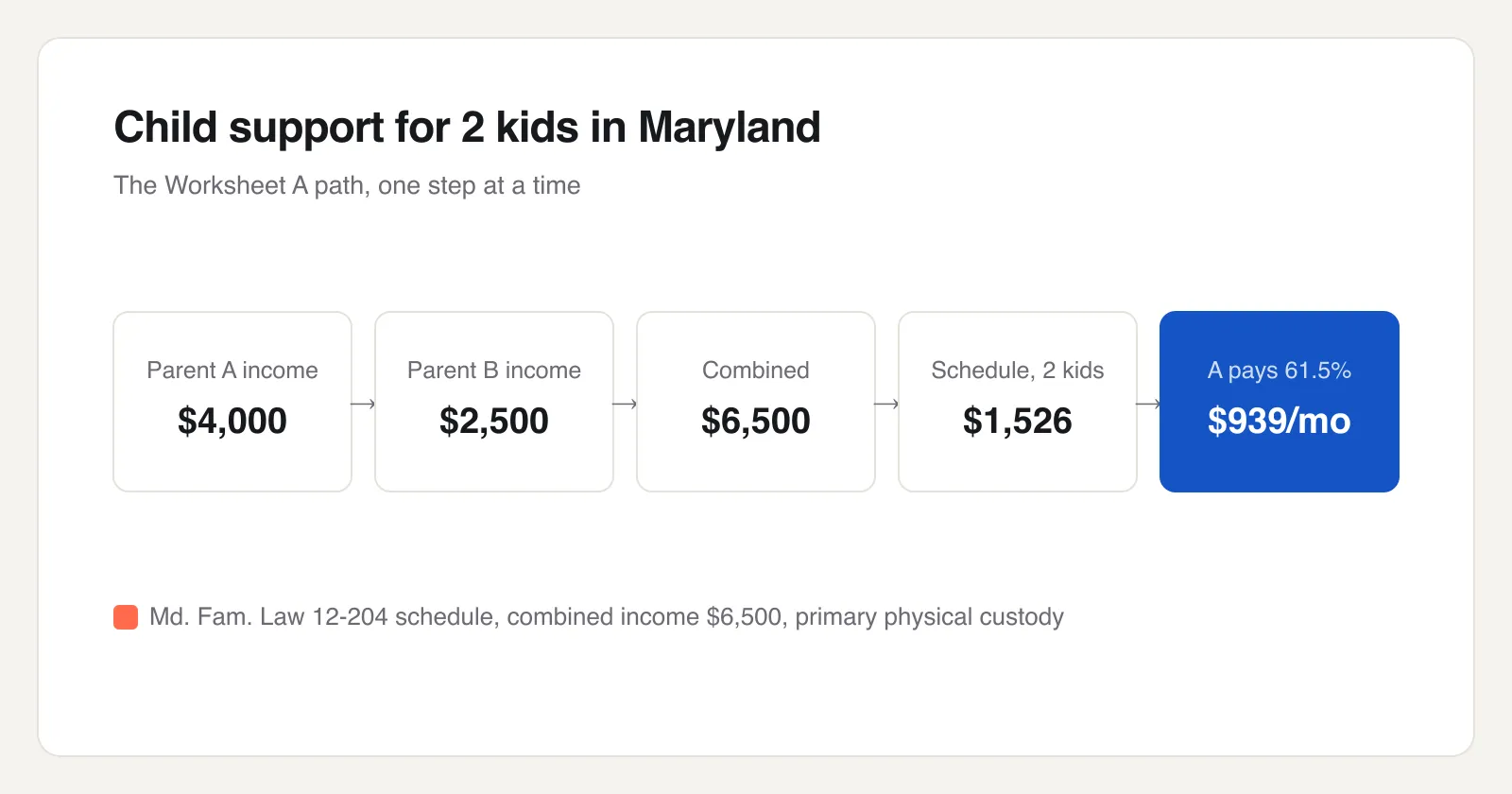
Maryland is an income shares state, computed on actual income, meaning gross monthly income from essentially all sources before taxes. The court worksheet (form CC-DR-034 for primary physical custody) runs four steps:
- Take each parent’s monthly actual income, minus a few adjustments such as preexisting support orders and alimony in this case.
- Combine the two incomes.
- Look up the combined figure in the 12-204(e) schedule under the 2-children column. Between printed rows, Maryland rounds up to the next higher schedule amount rather than interpolating.
- Divide that obligation between the parents in proportion to income. The parent without primary custody pays their share to the other household.
The schedule runs to $30,000 of combined monthly income for cases filed on or after July 1, 2022; above that line the amount is up to the court’s discretion.
A worked example
Take a paying parent earning $4,000 a month, a receiving parent earning $2,500, 2 children, primary custody with the receiving parent, and no child care or health insurance add-ons.
Every figure comes from running the statutory schedule directly; our Maryland calculator reproduces this scenario, and automated tests hold the published numbers to the real formula on every build.
Guideline amounts at other incomes
The same procedure at other income mixes, still 2 children, primary custody, no add-ons:
| Payer / recipient income | Combined | Monthly transfer |
|---|---|---|
| $3,000 / $2,000 | $5,000 | $813.60 |
| $4,000 / $2,500 | $6,500 | $939.08 |
| $5,000 / $3,500 | $8,500 | $1,044.12 |
| $6,000 / $4,000 | $10,000 | $1,128.60 |
Notice the curve flattens as income rises: the schedule’s amounts grow slower than income does, so doubling the combined income does not double the obligation.
What moves the number most in Maryland
- Overnights, sharply. Once each parent keeps the children at least 92 overnights a year, Maryland abandons this worksheet entirely for the shared-custody Worksheet B, which multiplies the obligation by 1.5 and then offsets by both income and time. The same incomes can produce a dramatically lower transfer; the general mechanics are covered in do you pay child support with 50/50 custody.
- Add-ons. Work-related child care and the children’s health insurance premiums ride on top of the basic obligation, divided by the same income shares.
- Adjustments to income. Preexisting support orders and alimony actually paid reduce the income the worksheet reads, which shifts both the combined figure and each parent’s percentage.
Run your own numbers
Your incomes will not match the examples, and a $500 difference moves the row. The calculator runs the same 12-204 schedule with your actual figures:
The Maryland child support calculator page documents the full computation with dated citations, including the rounding rule, the add-on treatment, and the shared-custody switch. If your schedule is anywhere near equal time, run both worksheets before treating any Worksheet A number as your answer; the 92-overnight switch changes the result far more than most income differences do.
Questions parents ask
Is Maryland child support based on gross or net income?
Gross, essentially. Maryland computes on actual income, which is monthly income from nearly all sources before taxes, adjusted only for items like preexisting support orders and alimony in the case.
Is the amount per child or for both children?
One combined amount. The 12-204(e) schedule has a column for each number of children, and the 2-children column covers both together. Support for 2 kids is higher than for 1, but well short of double.
What if our combined income falls between schedule rows?
Maryland rounds up: the worksheet uses the next higher schedule amount rather than interpolating between rows. It is a small statutory detail that many unofficial calculators get wrong.