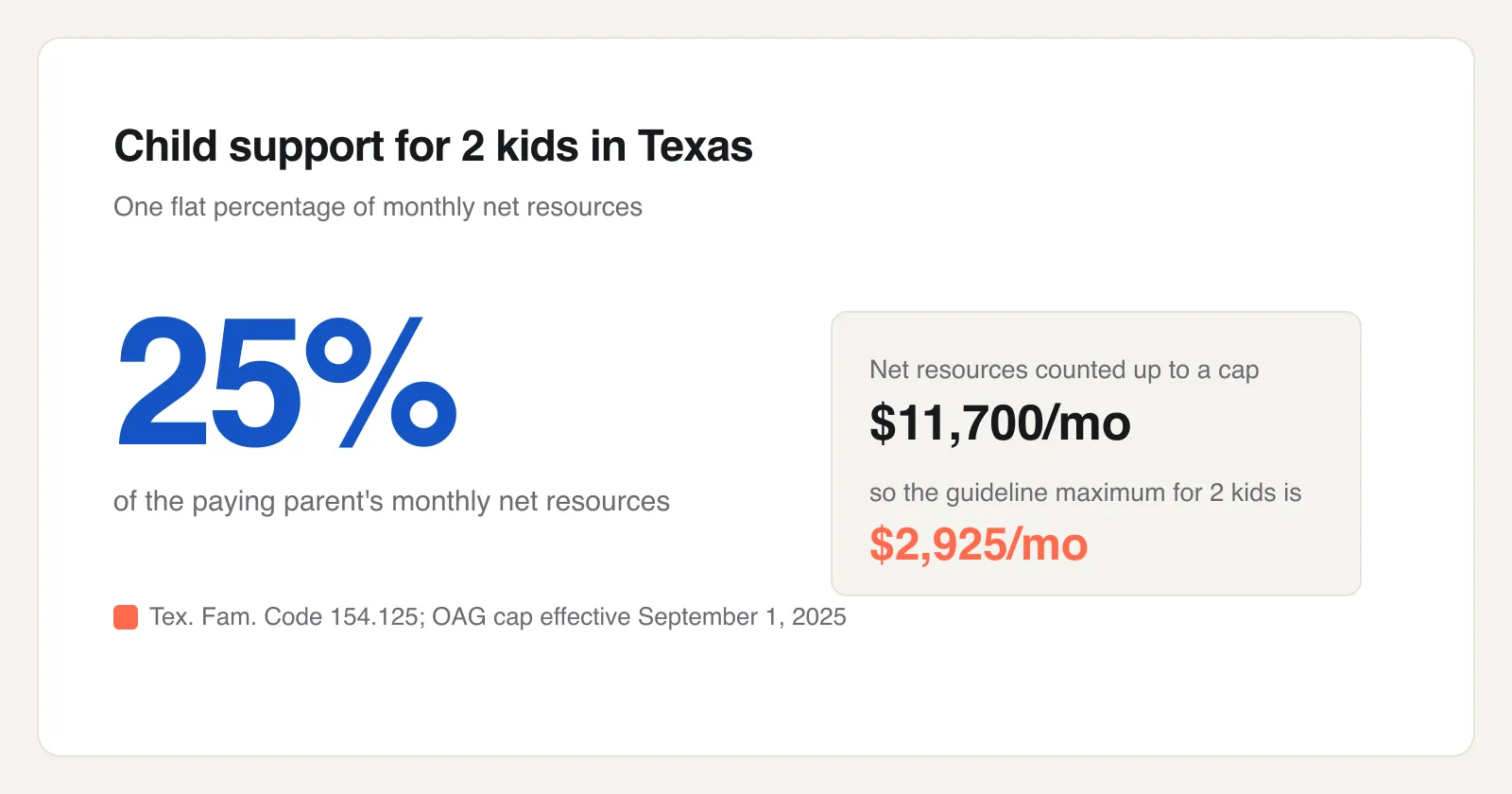
Texas gives a cleaner answer than almost any other state: for 2 children, guideline support is 25 percent of the paying parent’s monthly net resources. One parent’s income, one percentage. The receiving parent’s income does not enter the formula at all.
The catch is the phrase “net resources.” It is not your paycheck’s take-home amount, and it is not gross pay either. Getting from a salary to the actual guideline number takes three steps, and this post walks through them with figures you can check against the state’s own calculator.
Gross pay is not the base
Net resources start from nearly all income: wages, overtime, bonuses, self-employment income, rental income, even unemployment benefits. From that, the Family Code subtracts a short, fixed list:
- Social Security taxes (6.2 percent) and Medicare (1.45 percent)
- Federal income tax, computed as if the parent were single with one exemption, using the tax charts the Office of the Attorney General publishes each year
- Union dues actually paid
- The cost of the children’s health and dental insurance or cash medical support ordered
Nothing else comes off. Rent, car payments, and credit card bills do not reduce net resources.
A worked example you can verify
Take an employee grossing $5,000 a month with 2 children before the court and no other children to support.
That figure is not just our arithmetic. The official OAG calculator returns the same net resources and the same $1,049.79 for these inputs, and our Texas formula reproduces it in automated tests on every build.
The cap, and the low-income schedule
The 25 percent applies only up to a ceiling. Guideline support is computed on at most $11,700 of monthly net resources, the cap the OAG set effective September 1, 2025. A parent with $15,000 in net resources pays the same guideline amount as one with exactly $11,700: 25 percent of the cap, which is $2,925 a month for 2 children. Courts can order more above the cap only based on the proven needs of the children.
At the other end, parents with net resources under $1,000 a month use a reduced schedule: 20 percent instead of 25 for 2 children. At $900 in net resources, guideline support is $180 a month.
| Monthly net resources | Percentage | Guideline support |
|---|---|---|
| $900 | 20% | $180.00 |
| $4,199.17 | 25% | $1,049.79 |
| $11,700 (cap) | 25% | $2,925.00 |
When the percentage is not 25
Two situations change the number for 2 children:
- Other children. A parent who also has a legal duty to support children in another household uses the multiple-family table in section 154.128, which steps the percentage down. With 2 children in this case and 1 elsewhere, the percentage drops below 25.
- Deviation. The guideline is a rebuttable presumption. A court can vary from it when the evidence shows it would be unjust or inappropriate, though most orders track the guideline.
Texas also does not adjust the percentage for overnights the way many states do. A standard possession order and an expanded one usually produce the same guideline amount, which surprises parents moving from states where every overnight counts.
Questions parents ask
Is Texas child support 25 percent of gross pay?
No. The 25 percent for 2 children applies to net resources: income after Social Security, Medicare, federal income tax from the OAG charts, union dues, and the children's health insurance cost. For an employee grossing $5,000, that base is $4,199.17, not $5,000.
What is the most a Texas court will order under the guidelines?
Guideline support is computed on at most $11,700 of monthly net resources, so the 2-children guideline tops out at $2,925 a month. More is possible only through the children's proven needs, not the percentage.
Does the other parent's income matter in Texas?
Not in the guideline formula. Texas is a percentage-of-income state, so the calculation reads one parent's net resources. Courts can weigh both households when deciding whether to deviate.
Check your own number
Salaries, self-employment, union dues, and insurance all move net resources, so run your actual figures rather than rounding from these examples.
Use the Texas net resources calculator when you need only the gross-to-net step. The Texas child support calculator page documents the full computation, including the multiple-family table. If support may run above the cap in your case, the Texas high-income cap page covers how courts handle proven needs beyond $2,925.