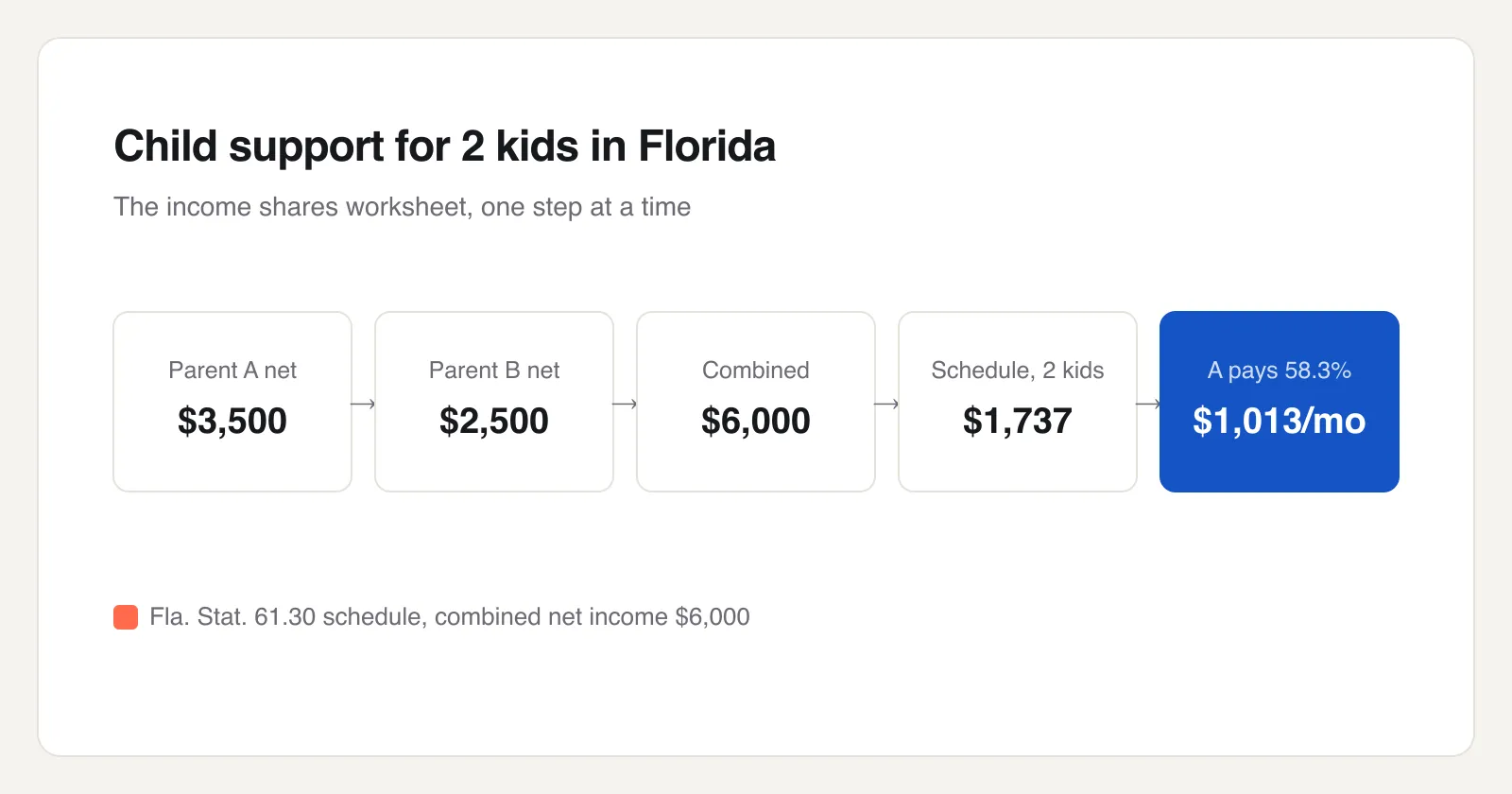
There is no single answer, and anyone who gives you one number without asking about income is guessing. Florida child support depends on what both parents earn, so the honest answer is a method: combine both net incomes, look up the amount the statute assigns to 2 children at that income, and split it in proportion to what each parent earns.
The good news is that the method is public. It sits in section 61.30 of the Florida Statutes, and you can run it yourself in a few minutes. This post walks through it with real numbers at several income levels.
The formula in plain words
Florida uses the income shares model. The idea: children should receive the same share of parental income they would have received in one household.
The worksheet runs in four steps:
- Work out each parent’s net monthly income. That is gross income minus allowed deductions like taxes, mandatory union dues, and health insurance premiums for the parent.
- Add the two nets together.
- Look up the combined amount in the 61.30(6) schedule under the 2-children column. That is the basic obligation both parents share.
- Split the obligation by income share. A parent who earns 60 percent of the combined income covers 60 percent of the obligation. The parent with less overnight time pays their share to the other household.
A worked example
Take a paying parent with $3,500 net a month and a receiving parent with $2,500, 2 children, no child care or health insurance add-ons, and fewer than 73 overnights a year for the paying parent.
Every figure above comes from running the statute’s schedule directly. Our Florida calculator reproduces this exact scenario, and its formula runs through fixture tests on every build.
Guideline amounts at other incomes
The same four steps at different combined incomes, still for 2 children, no add-ons, and no substantial time-sharing. The transfer column assumes the paying parent earns the larger income shown.
| Payer net / recipient net | Combined | Schedule amount | Monthly transfer |
|---|---|---|---|
| $2,500 / $1,500 | $4,000 | $1,288 | $805.00 |
| $3,500 / $2,500 | $6,000 | $1,737 | $1,013.25 |
| $5,000 / $3,000 | $8,000 | $2,004 | $1,252.50 |
| $7,000 / $5,000 | $12,000 | $2,378 | $1,387.17 |
The last row shows the high-income rule. The printed schedule stops at $10,000 of combined net income. Above that line, 61.30(6)(b) adds a percentage of the extra income: 7.5 percent for 2 children. At $12,000 combined, that is the $2,228 schedule amount at $10,000, plus 7.5 percent of the extra $2,000, for a $2,378 basic obligation.
What changes the number
Three things move the guideline amount most often:
- Overnights. Once each parent has the children at least 73 nights a year, which is 20 percent, the statute switches to a different method: the basic obligation is multiplied by 1.5 and offset between the households based on each parent’s share of nights and income. A parent close to that line should run both scenarios, because crossing it can change the transfer a lot.
- Add-ons. Work-related child care and the children’s health insurance premiums are added on top of the basic obligation and split by the same income shares, with credit to whoever actually pays the bill.
- The judge. The guideline is a presumption, not a command. A court can adjust the number up or down 5 percent after weighing the case, and further only with written findings under 61.30(1)(a).
Florida also protects low earners. Under 61.30(6)(a), the obligation is capped at 90 percent of the amount by which the paying parent’s net income exceeds the federal poverty guideline for one person, so a guideline order does not reach below subsistence income.
Questions parents ask
Is the schedule amount per child or for both children together?
It is one combined amount for both children. The 61.30(6) schedule has a separate column for each number of children, and the 2-children column already covers both. Support for 2 children is more than for 1, but not double.
Does 50/50 custody mean no child support in Florida?
Not automatically. With equal time the statute's gross-up method offsets each parent's obligation, so a transfer usually remains whenever incomes differ. The parent who earns more generally still pays something.
Is there an official Florida child support calculator?
The state publishes the worksheet as Family Law Form 12.902(e), but no official interactive calculator. Any online number, ours included, is an estimate; the court's completed worksheet controls.
Run your own numbers
Your real incomes, your overnight schedule, and your add-ons will move the result, so treat every figure above as a worked illustration rather than your answer.
For the full picture of Florida’s rules, the Florida child support calculator page documents the schedule, the time-sharing method, and the deviation rules with dated citations. If overnights are the open question in your case, count them precisely with the parenting time calculator before you run the money numbers.