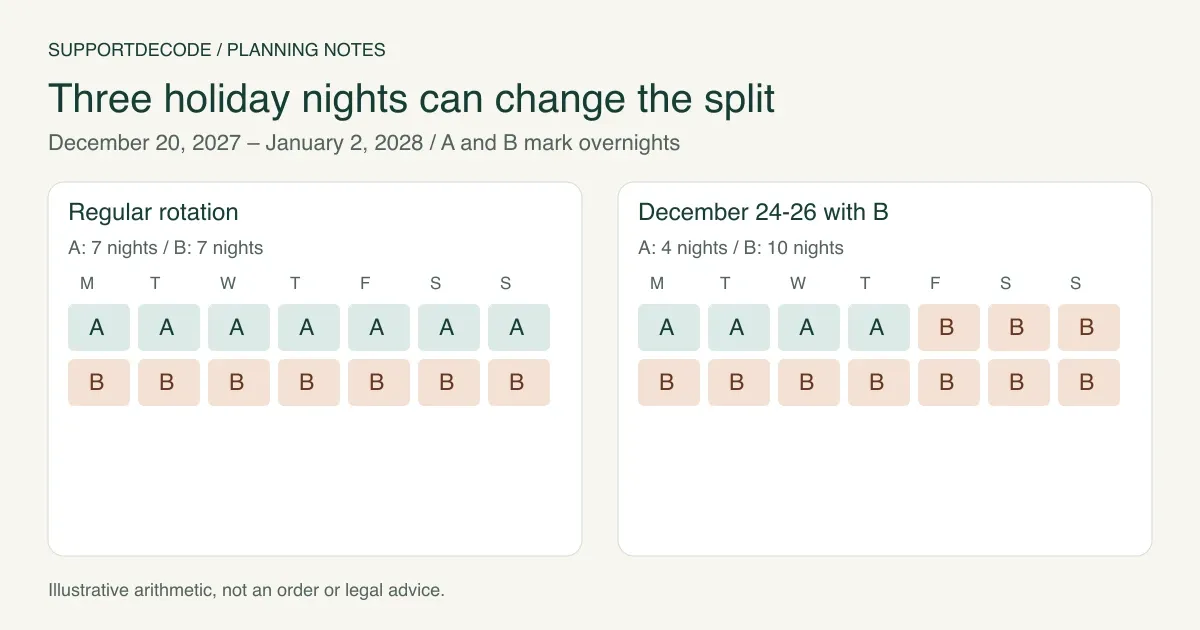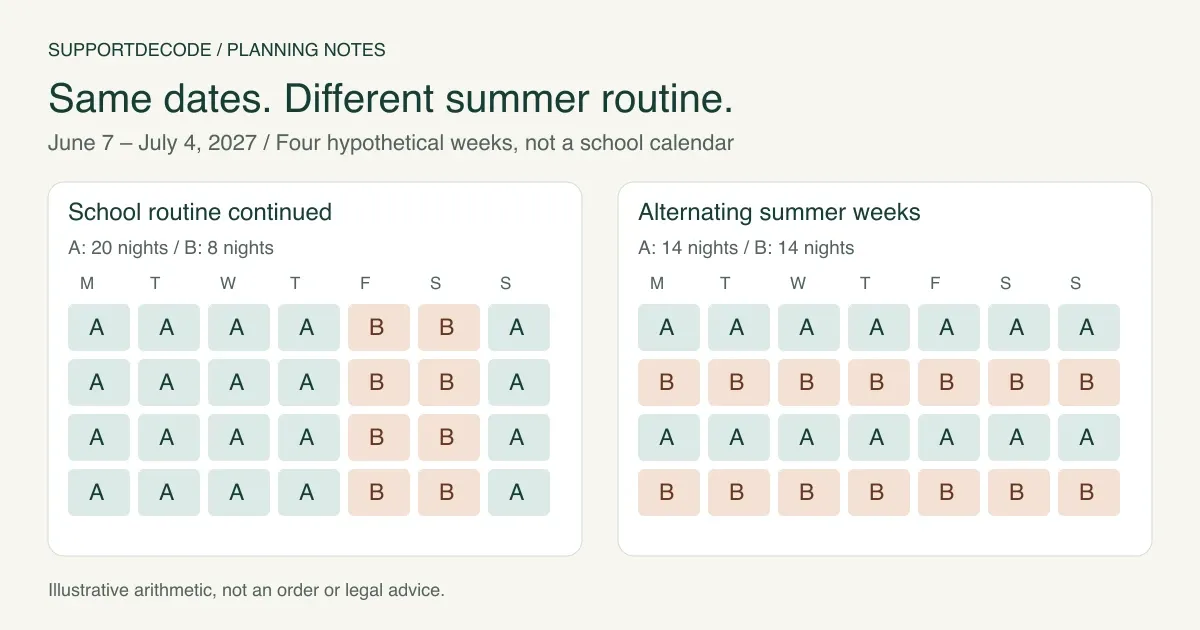

A parenting schedule tells you which nights belong to each household. A usable plan also answers what happens at an exchange, on a holiday, or when a new expense comes up.
This is an editorial checklist of questions, not a survey of parents, a legal template or a promise that a clause is enforceable. State rules and existing court orders control. California’s court guidance on detailed custody orders illustrates why exact times and locations matter; its forms are for California, not every state.
1. Exchanges and school-day exceptions
Can someone reading the schedule identify the time, location and transportation arrangement? What changes if school is closed? Where are necessary medicines, school supplies and contact information kept?
A concrete planning example is the difference between “Friday” and a specified Friday exchange time and location. This checklist does not prescribe which arrangement your order should contain.
2. Holidays, breaks and vacations
Does a holiday override the regular rotation? What are its start and end times? Is it assigned by odd/even year, and how are school-calendar changes handled?
The holiday schedule builder can organize a proposed table. It does not create a court-approved attachment. The custody calendar generator helps test the ordinary rotation before exceptions are applied.
3. Expenses and records
Which expenses are already addressed by the support order? Which additional costs require agreement? How will receipts be exchanged and reimbursements documented?
The expense split calculator compares arithmetic shares. Its result does not make an expense reimbursable or change a court-ordered allocation. Avoid counting the same expense in both support and a separate proposed split.
4. Tax questions are separate questions
A sentence saying parents alternate “claiming the child” does not settle every federal tax benefit. Under the special rule explained in IRS Publication 504, a qualifying release can allow the noncustodial parent to claim certain child-related benefits. It does not transfer head-of-household status, the earned income credit or the dependent-care credit.
Form 8332 and its instructions explain the release, the years covered and revocation. Eligibility and other conditions still matter. Our who claims the child guide is a starting point for those questions, not a tax filing determination.
5. Communication, childcare and changes
How will routine information be shared? Who receives school notices? If a proposed plan includes an offer of childcare to the other parent before using a sitter, what situations would it cover? This is a topic to discuss, not a universally required clause.
For a possible move or schedule change, use the local court’s rules about notice, relocation and changing an order. Do not assume a private agreement overrides those requirements. A useful worksheet can have a “needs local advice” column instead of inventing a deadline.
6. Safety before a joint planning process
This checklist does not assume parents can safely negotiate, meet at exchanges or mediate together. Abuse, coercion, protective orders and supervised-contact requirements need case-specific handling. The California Courts safety resource describes how safety concerns can change custody and visitation arrangements. For another state, its court self-help center is the relevant starting point.
A simple way to organize the questions
Use three headings on your own worksheet: “Already covered by the order,” “Unclear,” and “Needs local review.” Work through an ordinary school week, then a holiday week. The aim is to identify missing details, not to generate legal clauses automatically.
Questions parents ask
What belongs in a parenting plan checklist?
Questions about the ordinary schedule, exchange details, holidays, expenses, communication, tax issues and safety. The required terms and legal process depend on the state and any existing order.
Does this checklist create an enforceable parenting plan?
No. It is a planning aid, not a legal form. Use the applicable court forms and local guidance about reaching, approving or changing an order.
Does Form 8332 transfer every child-related tax benefit?
No. It has a limited purpose and conditions. It does not transfer head-of-household status, the earned income credit or the dependent-care credit.