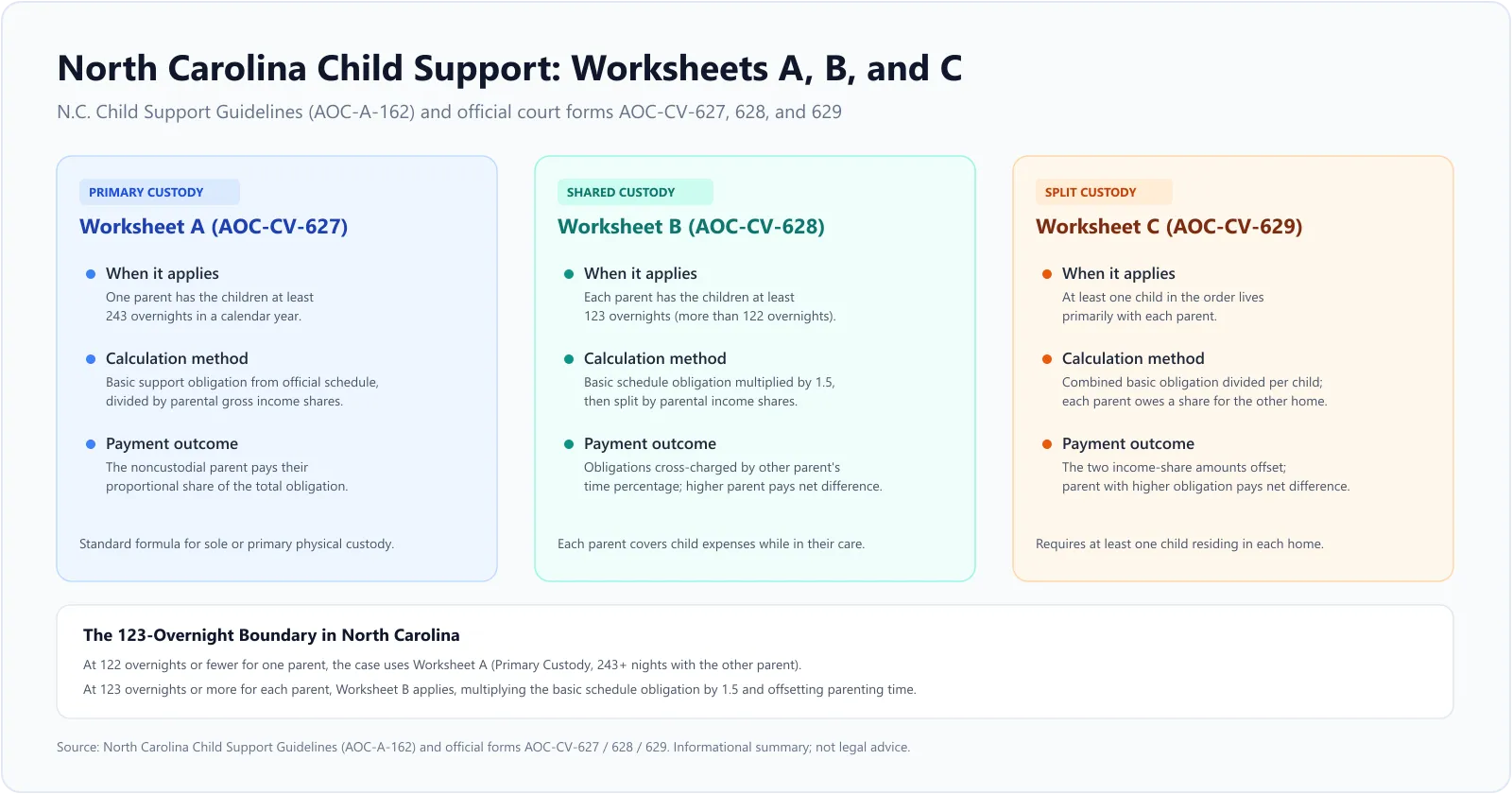
North Carolina uses three different worksheets to calculate child support: Worksheet A, Worksheet B, and Worksheet C. The right form depends on where the children spend their overnights each year.
Picking the wrong worksheet changes the formula. Each custody arrangement follows separate rules under the North Carolina guidelines (AOC-A-162). That includes primary custody, shared custody, and split custody.
Which North Carolina worksheet applies to your case?
The state court system provides specific forms for each living arrangement:
| Worksheet | When it applies | Calculation method |
|---|---|---|
| Worksheet A (AOC-CV-627) | Primary custody with 243 or more overnights per year | Basic schedule obligation split by income shares; noncustodial parent pays proportional share |
| Worksheet B (AOC-CV-628) | Shared custody with 123 or more overnights per year | Schedule amount multiplied by 1.5 and offset by parenting time percentage |
| Worksheet C (AOC-CV-629) | Split custody with at least one child living primarily in each home | Basic obligation split per child; each parent owes an income share for the children in the other home; the two offset |
The 123-overnight boundary between Worksheet A and Worksheet B
Overnight counts establish which worksheet applies. Form AOC-CV-628 instructions state that shared custody applies when children spend more than 122 overnights per year with each parent. That standard requires at least 123 overnights per child.
When one parent has 122 overnights or fewer, the other parent has 243 or more. That schedule requires Worksheet A. It applies to primary custody cases.
Worksheet B also requires each parent to pay the children’s expenses during their own time.
Worksheet B multiplies the basic schedule obligation by 1.5. Each parent is then charged based on the time the child spends with the other parent. The two amounts offset against each other. The parent with the higher figure pays the net difference.
Worked example: 122 overnights compared to 123 overnights
To see the difference, consider two parents supporting one child:
- Paying parent gross monthly income: $4,800 (60% share)
- Receiving parent gross monthly income: $3,200 (40% share)
- Combined gross monthly income: $8,000
On the official schedule, the basic obligation for $8,000 combined income for one child is $1,152.
Worksheet A calculation at 122 overnights
Suppose the paying parent has 122 overnights. The receiving parent has 243 overnights. Worksheet A applies. The paying parent owes 60% of the $1,152 schedule amount:
- $1,152 x 60% = $691.20 per month.
Worksheet B calculation at 123 overnights
Now suppose the paying parent reaches 123 overnights. The receiving parent has 242 overnights. Because both parents exceed 122 overnights, Worksheet B applies:
- Multiply the schedule obligation by 1.5: $1,152 x 1.5 = $1,728.
- Divide by income shares: 60% of $1,728 is $1,036.80 for the paying parent. 40% is $691.20 for the receiving parent.
- Multiply each share by the time the child spends with the other parent:
- Paying parent obligation: $1,036.80 x (242 / 365) = $687.41.
- Receiving parent obligation: $691.20 x (123 / 365) = $232.92.
- Offset the two numbers: $687.41 minus $232.92 gives $454.49 per month.
| Calculation step | Worksheet A (122 nights) | Worksheet B (123 nights) |
|---|---|---|
| Combined monthly gross income | $8,000 | $8,000 |
| Basic schedule obligation | $1,152 | $1,152 |
| Worksheet B 1.5 multiplier applied | No (1.0x) | Yes ($1,728 shared basic) |
| Paying parent preliminary share (60%) | $691.20 | $1,036.80 |
| Cross-obligation for other parent time | None | $687.41 (payer) / $232.92 (recipient) |
| Presumptive monthly child support | $691.20 | $454.49 |
Moving from 122 overnights to 123 overnights creates a monthly difference of $236.71 ($691.20 minus $454.49). Crossing this boundary shifts the formula. The calculation changes from primary custody to the 1.5 shared multiplier and time offset.
When Worksheet C applies for split custody
Worksheet C (Form AOC-CV-629) applies to split custody. It requires two or more children in the support order. At least one child must live primarily with each parent.
Under Worksheet C, at least one child must remain in each home. The combined basic obligation is divided per child. Each parent owes an income-share amount for the children living in the other home. The two amounts offset. The parent with the higher amount pays the difference.
Using calculators and official state worksheets
Online estimates require accurate entries. Parents should verify their numbers first:
- For Worksheet B, the North Carolina child support calculator asks for the paying parent’s total overnights across all children. Remaining nights out of 365 per child go to the other parent.
- For Worksheet C, the calculator asks how many children live primarily with the paying parent. At least one child must remain in each home.
- To track overnights, use the parenting time calculator or see how many overnights make up 50/50 custody.
North Carolina Child Support Services provides electronic versions of Worksheets A, B, and C on its eCoA portal.
Questions parents ask
What overnight threshold triggers North Carolina Worksheet B?
Each parent must have at least 123 overnights per year under Form AOC-CV-628 instructions.
What does Worksheet B do with the 1.5 multiplier?
It multiplies the schedule amount by 1.5 and splits it by income shares. Each parent is charged for the other parent’s time, and the two amounts offset.
What is the difference between shared custody and split custody in North Carolina?
Shared custody requires 123 or more overnights in each home, whereas split custody requires at least one child living primarily with each parent.