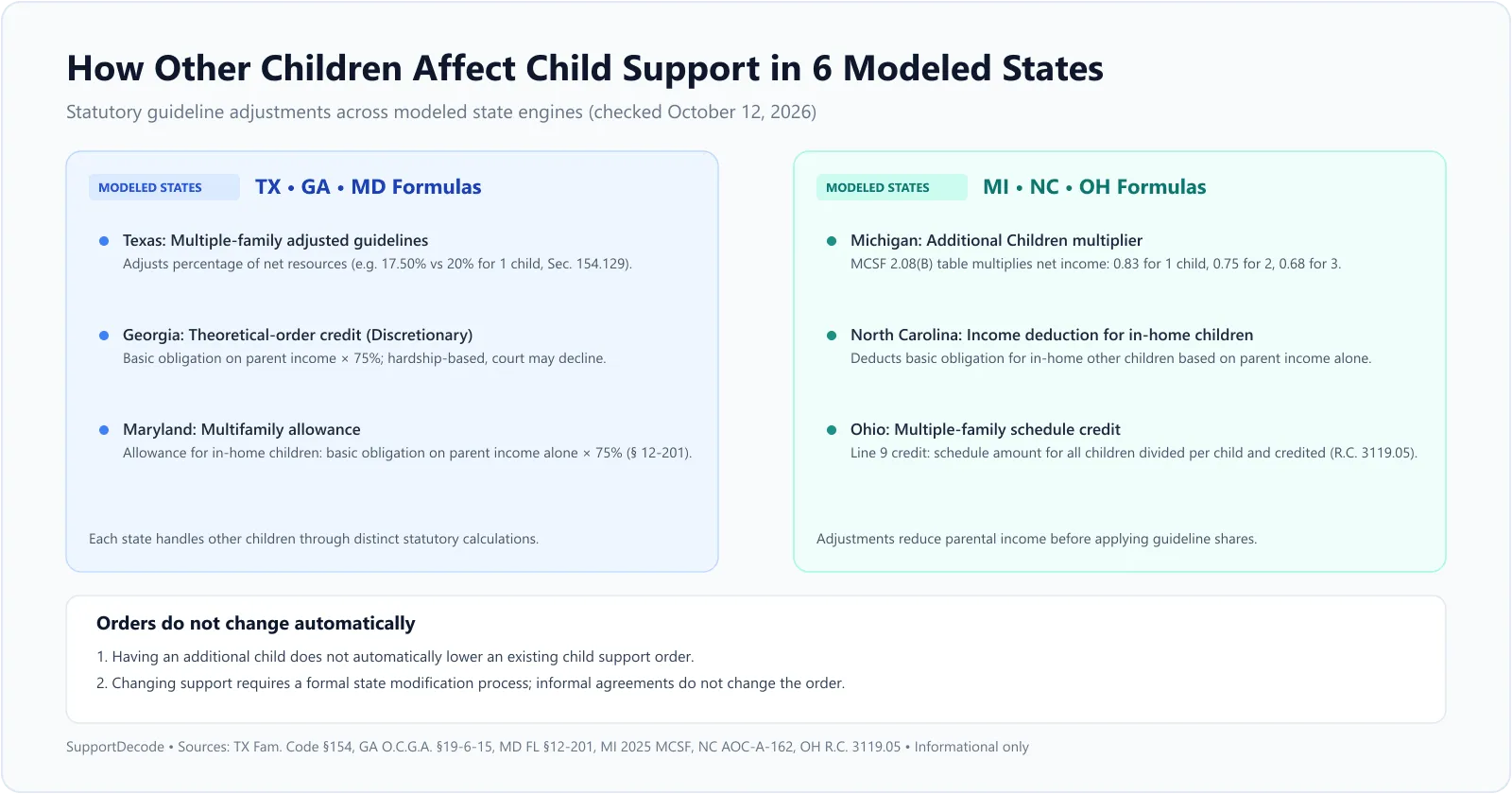
Having a new baby does not lower child support automatically. An existing court order stays in effect until modified through the formal state process. Informal agreements between parents do not change the ordered payment.
When parents seek a modification, other children can affect the calculation. Six states modeled on this site adjust guideline support for a parent’s other children. Each state applies a different statutory formula. Some adjustments are discretionary. Rules in other states differ. Check the state child support calculators for local guidelines.
How six modeled states handle other children
State guidelines treat additional children through distinct statutory formulas. The table below outlines how the six modeled states adjust calculations:
| State | Statutory mechanism | How other children are handled |
|---|---|---|
| Texas | Multiple-family adjusted guidelines (Sec. 154.129) | Adjusts the percentage applied to net resources based on the number of other children supported. |
| Georgia | Theoretical-order credit (O.C.G.A. § 19-6-15(f)(5)(C)) | Discretionary credit: basic obligation for in-home children at parent income times 75%. |
| Maryland | Multifamily allowance (§ 12-201(c)(2)) | Allowance for in-home other children: basic obligation on parent income alone times 75%. |
| Michigan | Additional Children table (MCSF 2.08(B)) | Multiplies payer net income: 0.83 for 1 child, 0.75 for 2, 0.68 for 3, 0.64 for 4, 0.60 for 5+. |
| North Carolina | Responsibility for other children (AOC-A-162) | Deducts basic obligation for in-home other children on parent income alone. |
| Ohio | Multiple-family credit (R.C. 3119.05 / JFS 07768) | Schedule amount for all children divided per child and credited for other children. |
Georgia: discretionary credit under state law
Georgia requires special attention. Under O.C.G.A. Section 19-6-15(f)(5)(C), credit for qualified other children in the paying parent’s home is discretionary. The court evaluates whether denying the credit creates substantial hardship. The court may decline the adjustment based on case circumstances.
Worked example: Texas multiple-family guideline calculations
To see how an additional child affects a calculation, look at Texas. Texas sets guideline support as a direct percentage of the paying parent’s net resources. Consider a paying parent with $4,000 in monthly net resources and one child before the court:
- With 0 other children: Under Texas Family Code Section 154.125, the standard guideline rate is 20%. The monthly support payment is $800.
- With 1 other child: Under Texas Family Code Section 154.129, the multiple-family adjusted rate drops to 17.50%. The monthly support payment becomes $700.
The adjustment reduces the guideline calculation by $100 per month. The percentage applied depends on the number of other children the parent has a duty to support.
| Scenario | Guideline percentage | Monthly child support |
|---|---|---|
| 0 other children (Sec. 154.125) | 20% | $800 |
| 1 other child (Sec. 154.129) | 17.50% | $700 |
Texas modification rules: what the agency says
A new child does not change an existing support order on its own. In Texas, the Office of the Attorney General outlines specific rules for modifying an existing order:
- Material and substantial change: Becoming legally responsible for additional children qualifies as a material and substantial change in circumstances.
- Three-year eligibility route: Orders older than three years qualify if the amount differs by 20% or $100.
- Formal process required: Only a court hearing or the Child Support Review Process changes support. Informal agreements do not.
- Payments could increase: The agency notes that support amounts could go up rather than down. Modifications use the noncustodial parent’s current income. If earnings have risen, the recalculation can increase the payment.
For general modification principles, read the guide on when child support can change.
Calculate your state child support payment
To see how state math applies to your family, use the state calculator for your jurisdiction:
- Texas child support calculator
- Georgia child support calculator
- Maryland child support calculator
- Michigan child support calculator
- North Carolina child support calculator
- Ohio child support calculator
Questions parents ask
Does having a new baby automatically lower child support?
No. An existing order stays in effect until modified through court or agency proceedings. Informal agreements between parents do not change the legal obligation.
How does Texas adjust child support for other children?
Texas Family Code Section 154.129 reduces the percentage applied to net resources. Support for 1 child drops from 20% with no other children to 17.50% with 1 other child.
Is the Georgia credit for other children guaranteed?
No. Georgia theoretical-order credit under O.C.G.A. Section 19-6-15(f)(5)(C) is discretionary and based on hardship. The court may decline the adjustment.
Can child support go up after requesting a modification?
Yes. The Texas Office of the Attorney General notes that support could go up because modifications use current income. Increased earnings can yield a higher payment.