The interest goes to whoever is owed the past-due support. In most cases that is the parent who should have received it. When the family received public assistance and the support was assigned to the state, the state keeps that part.
Archived 1998 federal guidance (OCSE-AT-98-24) classifies interest on arrearages as an arrearage payment. Under that guidance, interest is distributed as past-due support for that same time period. State law determines whether the original arrearage or accrued interest is paid first. Texas, for example, defines state-owed arrears as the portion of the balance that the state is entitled to retain under state and federal law (Form 1575). Credits under its Arrears Payment Incentive Program reduce only state-owed arrears. They cannot reduce amounts owed to the custodial parent.
When a payment reaches the interest
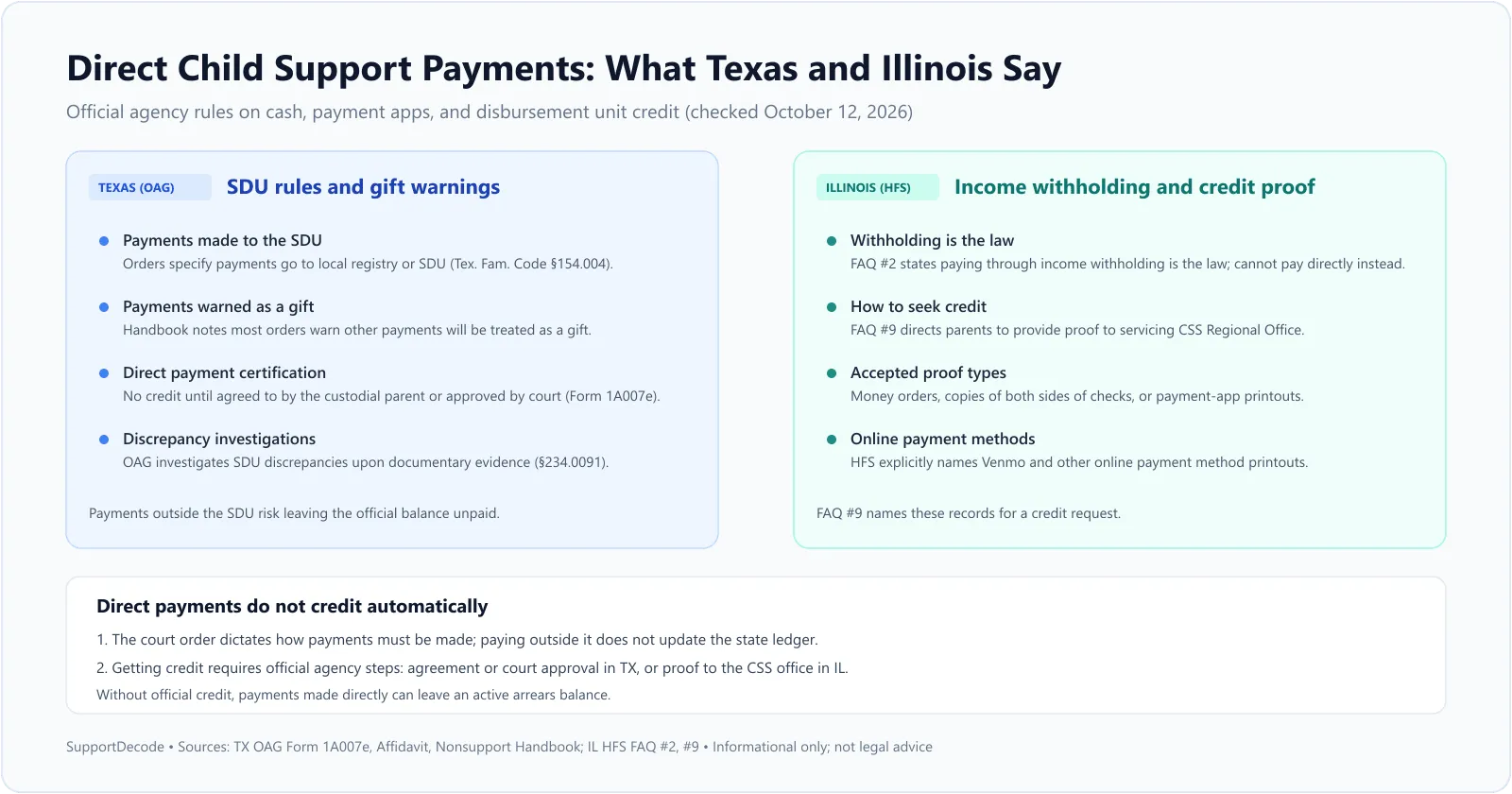
State laws specify when incoming payments reach accrued interest. Under Texas law, payments do not apply toward arrears until current obligations are met. Current month child support and medical support obligations must be satisfied first (Form 1575).
Texas OAG Form 1575 gives an official example. The case has arrears of $5,000.00 and a monthly current obligation of $400.00 ($350.00 child support plus $50.00 medical support). A $600.00 payment puts $400.00 toward current obligations and $200.00 toward arrears.
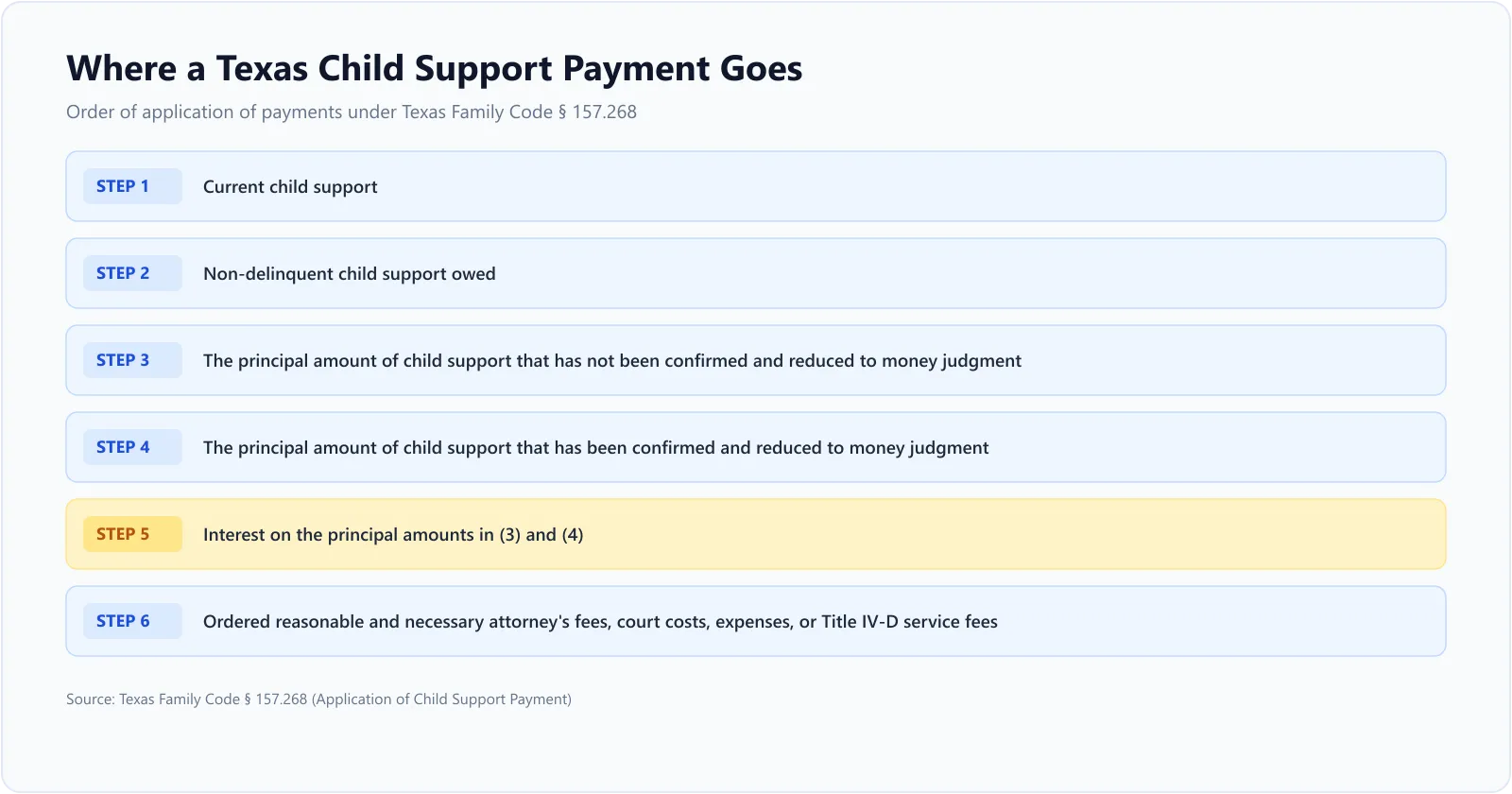
Texas Family Code § 157.267 provides that accrued interest is part of the child support obligation. It may be enforced by any means provided for collecting child support. Section 157.268 sets the statutory priority order:
- Current child support.
- Non-delinquent child support owed.
- The principal amount of child support that has not been confirmed and reduced to money judgment.
- The principal amount of child support that has been confirmed and reduced to money judgment.
- Interest on the principal amounts in (3) and (4).
- Ordered reasonable and necessary attorney’s fees, court costs, expenses, or Title IV-D service fees.
The Texas OAG re-entry handbook states that delinquent child support accrues 6% simple interest per year. It also states that payments made toward arrears go to the principal balance first.
Illinois establishes a similar priority rule under 735 ILCS 5/12-109. Each month’s payments go first to that month’s support. Payments above that obligation go to the unpaid balance from earlier months. Any payments in excess of current monthly support and unpaid balance apply to accrued interest. Federal income tax refund intercepts go to the unpaid child support balance. Accrued interest is not added to the unpaid balance when calculating the next month’s interest. Interest may be collected by any means available for collecting child support.
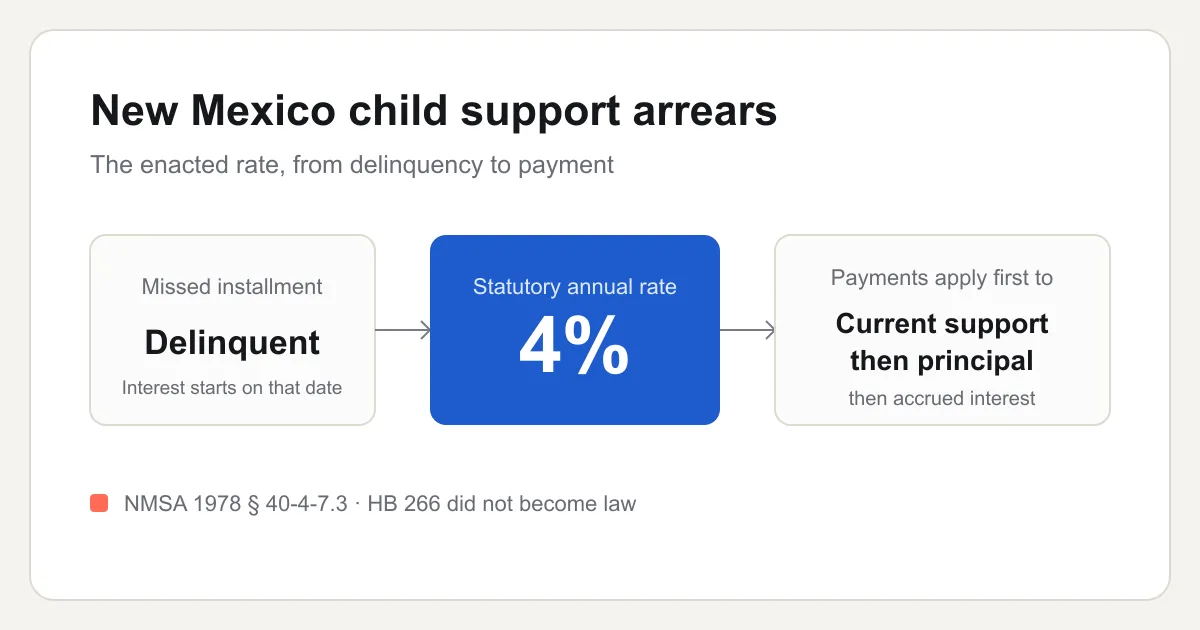
New Mexico sets an explicit statutory application order under Section 40-4-7.3 NMSA 1978. Payments apply to current support first. They next apply to delinquent support and consolidated principal. Remaining amounts apply to accrued interest. Delinquent child support in New Mexico accrues simple interest at 4% annually.
In all three states, payments reach accrued interest only after current support and principal are paid. Once those are paid, later payments go to the interest that is left.
Can the interest on child support arrears be adjusted or waived?
The sources for three states show three different rules:
- Texas: Form 1575 notes that incentive credits reduce only state-owed arrears. They cannot reduce the arrears balance owed to the custodial parent. They apply only to amounts the custodial parent would not otherwise receive.
- Arkansas: Under Ark. Code § 9-14-233, 10% annual interest applies to child support that becomes due and remains unpaid. It accrues unless the judgment owner or counsel asks in writing, before a judgment on arrears, that it not accrue.
- Washington: Under RCW 4.56.110 and WAC 388-14A-8600, judgments for unpaid child support bear 12% interest. The Division of Child Support does not assess or collect interest unless it has been reduced to judgment.
Parents should check their official court or agency ledger for recorded balances.
Comparing statutory interest and payment order
| State | Statutory interest rate | Payment priority order | Governing statute |
|---|---|---|---|
| Texas | 6% simple interest per year | Current support, then principal arrears, then accrued interest | Tex. Fam. Code § 157.265, § 157.268 |
| Illinois | 9% simple interest per year | Current support, then unpaid principal balance, then accrued interest | 735 ILCS 5/12-109 |
| New Mexico | 4% simple interest per year | Current support, then delinquent principal, then accrued interest | NMSA 1978 § 40-4-7.3 |
State arrears calculators and statutory guides
To model interest and balances under each state’s statutory rate, use the state calculators:
- Texas child support arrears calculator
- Illinois child support arrears calculator
- New Mexico child support arrears calculator
- Arkansas child support arrears calculator
- Washington child support arrears calculator
For broader legal rules and state rate comparisons, read the child support arrears interest guide and the 50-state arrears interest research table.
Questions parents ask
Who gets the interest on child support arrears?
Interest goes to whoever is owed the past-due support. In most cases that is the parent owed the support. Federal guidance treats interest like the past-due support it grew on. So when the family received public assistance and support rights were assigned to the state, the state keeps the interest on the state-owed portion.
Does a child support payment pay off interest before principal?
Not in Texas, Illinois, or New Mexico. In those three states, the law sends payments to current support and past-due principal first. Payments reach accrued interest only after those balances are paid. Other states set their own order.
Can child support arrears interest be waived or adjusted?
Rules depend on state statute. In Texas, state incentive credits can reduce only state-owed arrears and cannot touch amounts owed to the parent. In Arkansas, 10% interest accrues unless the judgment owner or counsel submits a written request before judgment that it not accrue.