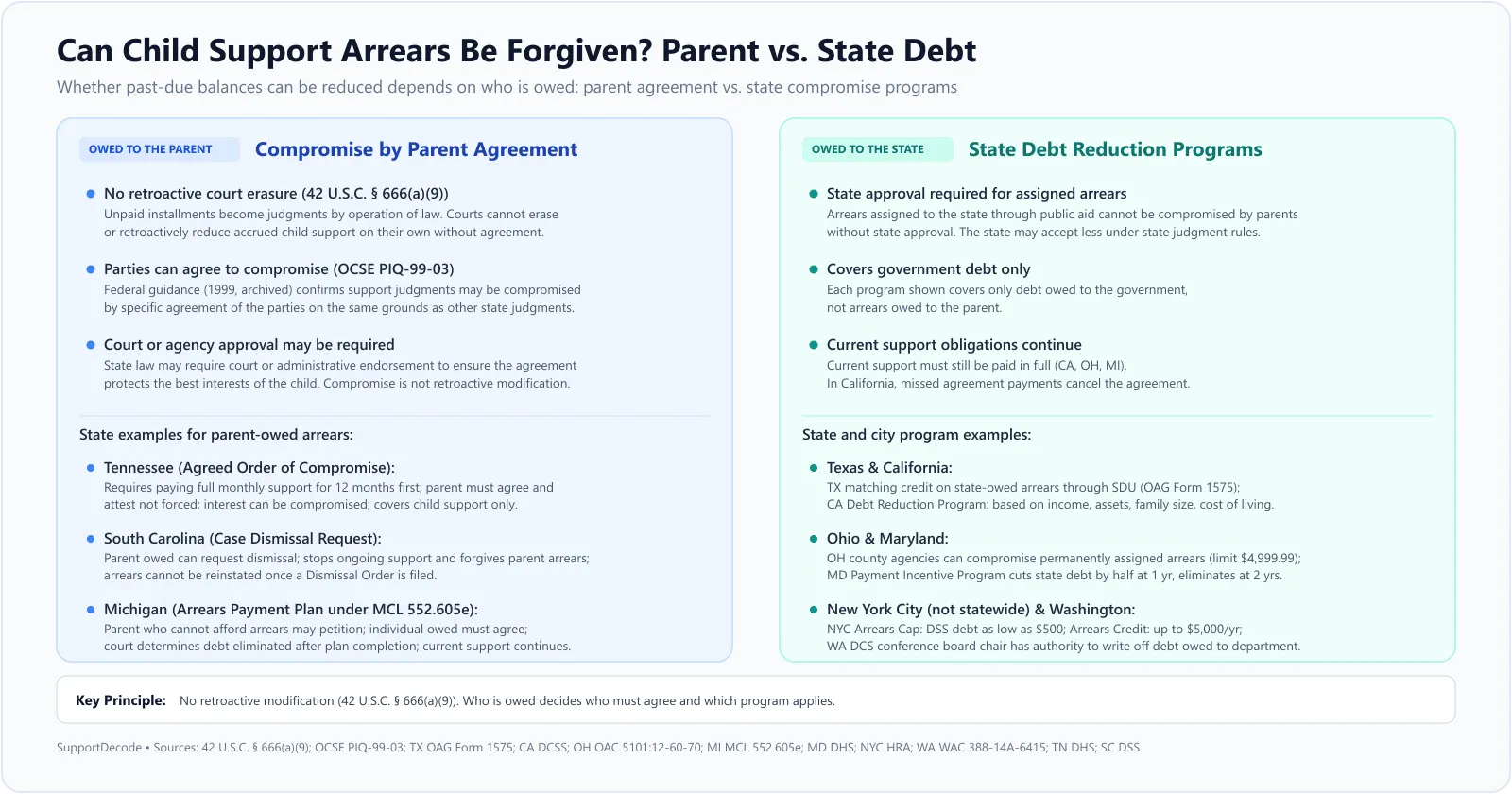
Past-due child support cannot simply be erased by a court. Under federal law (42 U.S.C. § 666(a)(9)), each unpaid installment becomes a judgment by operation of law on the date it is due. That statute prohibits retroactive modification of accrued support. Whether a past-due balance can be reduced depends on who is owed. The parent who is owed can agree to settle that debt. For arrears owed to the government, federal guidance requires the state to approve any compromise. Some states also run their own reduction programs.
If the arrears are owed to the other parent
Under archived 1999 federal guidance (OCSE PIQ-99-03), child support judgments may be compromised or satisfied by specific agreement of the parties. This compromise occurs on the same grounds that exist for any other judgment in the state. State law may require a court or administrative agency to endorse the agreement. That requirement ensures the best interests of the child are protected.
This compromise is distinct from retroactive modification. Prohibited retroactive modification happens when a court or agency erases or reduces accrued arrears without agreement. The agreement needed is from the person owed, or from the state when the state is owed.
In the three state examples below, arrears owed to a parent are reduced only with that parent’s agreement or request:
- Tennessee: Tennessee Department of Human Services provides an Agreed Order process. Parents sign an Agreed Order of Compromise and Settlement of Child Support Arrears. The paying parent must pay the full monthly obligation for at least 12 months first. The parent who is owed must agree and participate. That parent must attest they are not being forced, and must sign a written explanation of rights. The agreement can forgive some or all arrears owed to that parent. Interest can also be compromised. Settlement by a lump sum payment or a large item such as a car is encouraged. Debt compromise can be used once per case. It covers child support arrears only, not spousal or medical support. Money owed to Tennessee or other states cannot be forgiven. Once final, the order cannot be reversed except under extraordinary circumstances approved by the court. If family violence issues exist, separate appointments are scheduled. Both parties must also appear in court before a judge.
- South Carolina: South Carolina Department of Social Services provides a Case Dismissal Request. A parent who is owed can submit this request. Filing the form stops ongoing child support. It also forgives any arrears owed to that parent. Arrears cannot be reinstated once a Dismissal Order is filed.
- Michigan: Michigan law allows an Arrears Payment Plan under MCL 552.605e. A paying parent who cannot afford arrears may petition the court. If arrears are owed to an individual, that individual must agree to the plan. If approved, the court determines how much debt is eliminated after plan completion.
If the arrears are owed to the state
Arrears can be owed to the state when support rights were assigned to it. California gives one example. There, this debt is owed to the government if the children received cash aid or were in foster care while support went unpaid. Under OCSE PIQ-99-03, arrears assigned to the state cannot be compromised by the parents without state approval. A state may accept less than full payment on state-assigned arrears on the same grounds that exist for settling other state judgments.
The programs below were checked on official pages on October 13, 2026. Each one reduces only debt owed to the government:
| Jurisdiction | Program name | What it reduces | Key condition | Source |
|---|---|---|---|---|
| Texas | Arrears Payment Incentive Program | Dollar-for-dollar matching credit on state-owed arrears. | Credits only for voluntary or wage-withholding payments through the State Disbursement Unit. | Texas OAG Form 1575 |
| California | Debt Reduction Program | Part of the debt owed to the government. | Reduction based on income, assets, family size and local cost of living. | California DCSS |
| Ohio | Reduction of permanently assigned arrears (waiver, compromise or family support program) | Permanently assigned arrears. | County may approve up to $4,999.99 per case over its lifetime; larger requests go to the state. | Ohio Adm.Code 5101:12-60-70 |
| Maryland | Payment Incentive Program | State-owed arrears: half after a year of full payments, all after two years. | Gross income under 225% of the federal poverty level. | Maryland DHS |
| New York City (not statewide) | Arrears Cap; Arrears Credit Program | Cap: DSS debt as low as $500. Credit: up to $5,000 a year on DSS debt. | Cap: income below the poverty level when the debt built up. Credit: a full year of payments, asset limits. | NYC HRA / OCSS |
| Washington | DCS conference board | Debt owed to the department. | The conference board chair decides; relief can include writing off department debt. | WAC 388-14A-6415 |
In Michigan, state-owed debt can also be addressed through an Arrears Payment Plan under MCL 552.605e. When debt is owed to the state, the Office of Child Support must receive the court motion at least 56 days before the hearing. The agency then submits comments in support or opposition.
Worked example: Texas Arrears Payment Incentive Program
The Texas Office of the Attorney General provides an official example in Form 1575 showing how state matching credits work:
- A case has arrears of $5,000.00.
- The current monthly obligation is $400.00 ($350.00 for child support and $50.00 for medical support).
- Next month, the paying parent pays a total of $600.00.
Under Texas law, incoming payments satisfy current monthly obligations first:
- $400.00 applies to current month obligations.
- $200.00 applies to support arrears.
- An additional matching credit of $200.00 is earned to reduce state-owed arrears.
- The parent receives total payment credits of $800.00 on the case for that month.
Under Form 1575, matching credits are earned only on payments made voluntarily or through wage withholding through the State Disbursement Unit. Non-voluntary collections such as tax refund intercepts, liens, and levies do not earn matching credits. Payments made directly to the custodial parent also do not earn program credits.
The Texas OAG forms page continues to list Form 1575. It is used by delinquent noncustodial parents seeking to reduce debt owed to the State of Texas.
What these programs do not do
Each source sets limits:
- They do not reduce debt owed to the parent: Every state program listed above covers only government-owed debt. California, Maryland, Texas, and New York City say so on their program pages. Ohio limits reductions to permanently assigned arrears. Washington limits write-offs to debt owed to the department.
- They do not lower current support: Ongoing monthly child support responsibilities continue. In California, Ohio, and Michigan, rules state that an agreement does not change ongoing support. In those three states, current support must still be paid in full.
- Spousal support is excluded in two sources: California’s program does not reduce spousal support arrears, and Tennessee’s debt compromise covers child support arrears only.
Checking your balance and interest
Check the official agency or court ledger for the balance on a case. To see who receives the interest on past-due support, read our guide on who gets the interest on child support arrears.
Our arrears calculators cover Texas, California, Ohio, Michigan, Maryland, New York, Washington, Tennessee, and South Carolina.
Questions parents ask
Can the other parent forgive child support arrears?
Under archived federal guidance (OCSE PIQ-99-03), parents can enter into a specific agreement to compromise child support judgments owed directly to them. State law may require court or administrative approval. That approval ensures the agreement protects the child’s best interests.
Can a judge erase past-due child support?
Under 42 U.S.C. § 666(a)(9), past-due support installments become judgments that are not subject to retroactive modification. A balance can still be reduced in other ways. The sources describe an agreement by the person owed, a state program for state-owed debt, and state procedures such as Michigan’s court-approved Arrears Payment Plan.
What are state-owed child support arrears?
Texas defines state-owed arrears as the part of the balance that the state is entitled to keep under state and federal law once it is paid. California says this debt arises when the children received cash aid or were in foster care while support went unpaid.
Does a forgiveness program lower current support?
Not in the programs covered here. The California, Ohio and Michigan sources say current support continues in full. These programs apply only to past-due balances owed to the government.