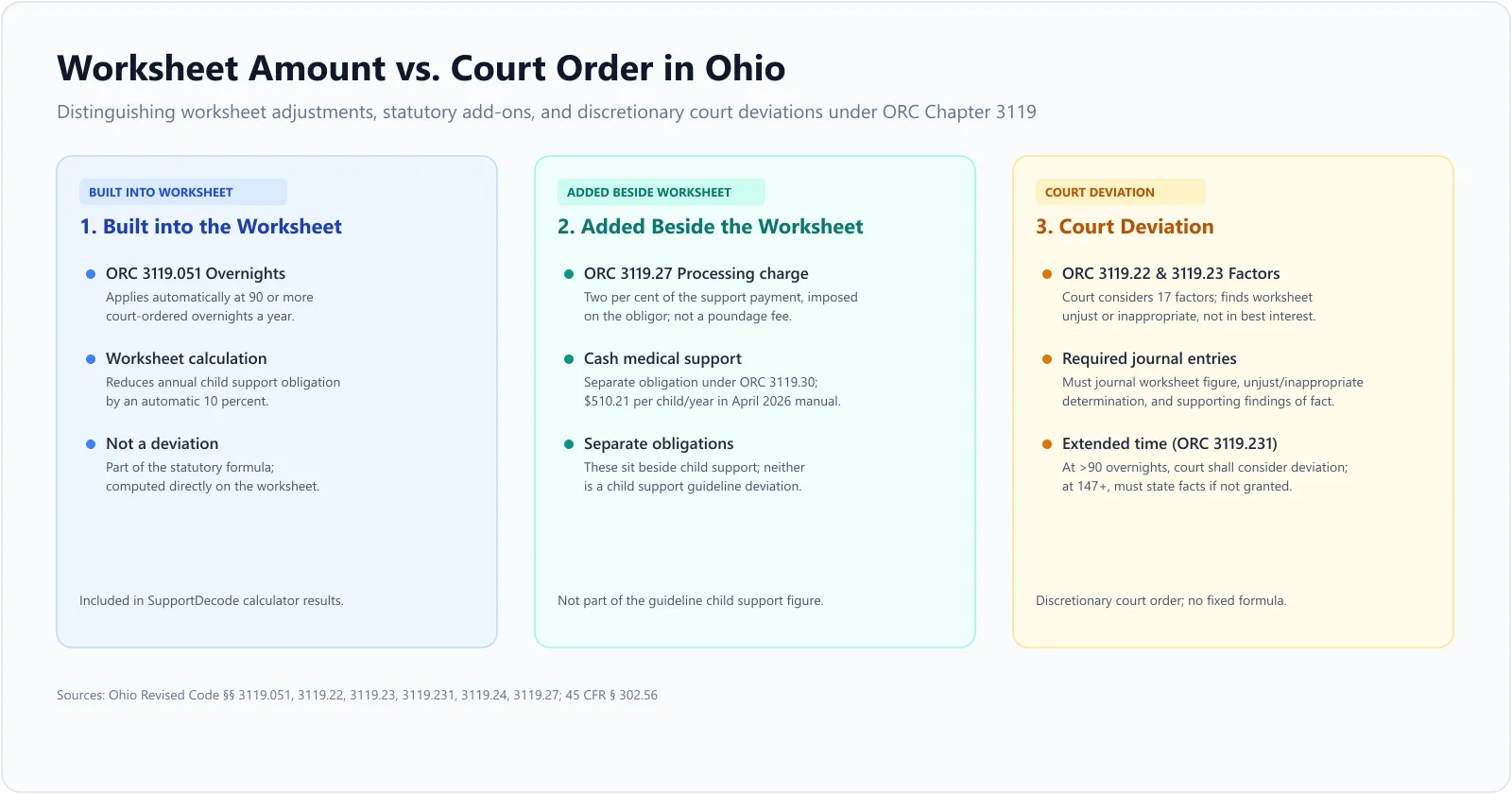
Under federal regulations (45 CFR § 302.56), the guideline calculation is presumed to be the correct child support amount. An Ohio court may order a different amount only after considering the statutory factors in ORC 3119.23. The judge must determine that the worksheet amount would be unjust or inappropriate and therefore not in the child’s best interest. If the court deviates, its journal entry must record three things. It must list the worksheet figure, that determination, and findings of fact. A parent can then compare the calculated worksheet number with what the judge ordered.
Is it a deviation, or something else?
In Ohio child support, an order can differ from a basic calculation for three reasons. Some adjustments are built into the worksheet formula. Other amounts sit beside the guideline figure as separate statutory obligations. A true deviation occurs when a court uses judicial discretion under ORC 3119.22. The judge then orders a payment that differs from the worksheet total.
| Category | Statutory authority | How it affects the payment |
|---|---|---|
| Built into worksheet | ORC 3119.051 | Automatic 10 percent reduction at 90+ overnights. Part of worksheet formula, not a deviation. |
| Added beside worksheet | ORC 3119.27, ORC 3119.30 | Two per cent processing charge; separate $510.21 cash medical support per child. |
| Court deviation | ORC 3119.22, 3119.24 | Court order that differs from the worksheet amount after a finding that the amount would be unjust or inappropriate and not in the child’s best interest. Requires findings of fact. |
The Ohio Revised Code uses the word “deviates” without limiting the adjustment to a lower number. An ordered deviation may result in an amount that is different, higher, or lower than the worksheet calculation. ORC 3119.22 does not use the words “upward” or “downward”.
The 17 deviation factors in Ohio (ORC 3119.23)
Under ORC 3119.22, a court must consider the statutory criteria in ORC 3119.23 before granting a deviation. The statute lists seventeen factors in divisions (A) through (Q):
- (A) Special and unusual needs of the child or children. This includes physical or psychological conditions.
- (B) Other court-ordered payments.
- (C) Extended parenting time or extraordinary costs associated with parenting time. This includes extraordinary travel costs when exchanging children.
- (D) Financial resources and earning ability of the child or children.
- (E) Relative financial resources of the parents. This includes income disparity between parties or households, other assets, and parental needs.
- (F) Receiving parent’s income, if at or below 100 percent of the federal poverty level.
- (G) Benefits either parent receives from remarriage or sharing living expenses with another person.
- (H) Federal, state, and local taxes actually paid or estimated to be paid.
- (I) Significant in-kind contributions. This includes direct payment for lessons, sports equipment, schooling, or clothing.
- (J) Extraordinary work-related expenses incurred by either parent.
- (K) Standard of living and circumstances of each parent. It also includes the standard of living the child would have enjoyed had the marriage continued or had the parents been married.
- (L) Educational opportunities the child would have had.
- (M) Responsibility of each parent for supporting others. This includes children with disabilities outside this order.
- (N) Post-secondary education costs a parent pays for their own children, even if emancipated.
- (O) Costs incurred, or reasonably anticipated, by the parents in complying with court-ordered reunification efforts in abuse, neglect, or dependency cases.
- (P) Extraordinary child care costs that exceed the maximum statewide average cost estimate described in ORC 3119.05(P)(1)(d). This includes care for specialized physical, psychological, or educational needs.
- (Q) Any other relevant factor. If the court grants a deviation based on this factor, the order must specifically state the facts behind the decision.
ORC 3119.23 states that the court “may consider” any of these factors. The statute does not rank the factors in priority order. It does not assign any fixed dollar amount or percentage weight to any factor.
Shared parenting orders (ORC 3119.24)
Under ORC 3119.24(A)(1), a shared parenting order still calculates support using the basic schedule and worksheet. Shared parenting does not replace the worksheet calculation.
The court may deviate from that amount if it finds the figure unjust or inappropriate to the children or either parent. The finding must determine that the worksheet amount is not in the child’s best interest. The court may base this deviation on the “extraordinary circumstances of the parents” or on any of the seventeen factors in ORC 3119.23. If the court deviates, it must enter the worksheet amount, its determination, and findings of fact in the journal.
Under ORC 3119.24(B), “extraordinary circumstances of the parents” includes:
- Ability of each parent to maintain adequate housing for the children.
- Parental expenses, including child care, tuition, medical, dental, and other relevant expenses.
- Any other circumstances the court considers relevant.
Parenting time overnights: the 90 and 147 rules
Ohio law provides two distinct rules regarding parenting time overnights in ORC 3119.051 and ORC 3119.231.
The first rule appears in ORC 3119.051. The worksheet applies an automatic 10 percent reduction at 90 or more court-ordered overnights a year. This adjustment is built into the worksheet math. It is not a deviation. The SupportDecode Ohio child support calculator computes this reduction automatically at 90 overnights.
The second rule appears in ORC 3119.231(A). If court-ordered parenting time exceeds 90 overnights per year, the court must consider granting a deviation under ORC 3119.23(C). This deviation is in addition to the 10 percent adjustment in ORC 3119.051.
ORC 3119.231(B) covers court-ordered parenting time of 147 or more overnights a year. At that level, if the court does not grant that deviation, it must specify in the order the facts behind its decision.
Neither statute gives a formula for the extra deviation under ORC 3119.231. The site’s calculator does not price it. You can count annual parenting time with our parenting time calculator before comparing your schedule with these statutory thresholds.
Worked example: worksheet calculation across overnight levels
To see how these rules work, consider an example run directly through Ohio’s guideline engine:
- Paying parent gross annual income: $60,000 ($5,000 monthly).
- Receiving parent gross annual income: $40,000 ($3,333.33 monthly).
- Children covered: 1 child.
- No out-of-pocket health insurance premiums, work-related child care, or other children.
Running these inputs through the engine produces these monthly figures:
- At 89 overnights: The annual support obligation is $7,921.00. The monthly support amount is $660.08. The worksheet applies no parenting-time reduction.
- At 90 overnights: The automatic 10 percent reduction under ORC 3119.051 subtracts $792.10 from the annual obligation. The monthly payment drops to $594.08.
- At 147 overnights: The worksheet calculation produces the same figure of $594.08. The engine notes that under ORC 3119.231, the court must consider an additional discretionary deviation. The order must state the facts if the judge refuses to grant one.
The 10 percent cut changes the guideline formula number. Any extra deviation comes only from the court, so no calculator can show it.
Amounts that sit beside child support
Two additional statutory amounts are established by Ohio law and sit beside child support:
- Processing charge (ORC 3119.27): Ohio imposes a processing charge of two per cent on the obligor on support collected under an order. The statute states that no court or agency may call the charge a poundage fee.
- Cash medical support (ORC 3119.30, 3119.302): Cash medical support is a separate obligation ordered alongside basic child support. The April 2026 Ohio Child Support Guideline Manual (JFS 07766) lists the annual cash medical support obligation as $510.21 per child. The SupportDecode calculator reports guideline child support only.
Two statutory income boundaries also apply where the basic schedule does not set the final order:
- Under ORC 3119.06, Ohio establishes a minimum child support order of $80 per month.
- Under ORC 3119.04, when combined annual income is above the $336,000 top of the schedule, the court decides the amount.
Comparing your order with the worksheet
If you want an estimate from the Ohio worksheet, use the Ohio child support calculator. To understand which state forms connect to that calculation, read our guide on the Ohio child support worksheet (JFS 07767 vs. 07768).
When an issued order differs from the worksheet figure, check the text of the order. Under ORC 3119.22 and ORC 3119.24, a deviating order must record the calculated worksheet amount. It must state the finding that the calculated figure would be unjust or inappropriate and not in the child’s best interest. The order must also list findings of fact supporting that conclusion.
Questions parents ask
What is a child support deviation in Ohio?
Under ORC 3119.22 and 45 CFR 302.56, a deviation is a court order that differs from the worksheet amount. An Ohio court may grant one only after considering the 17 factors in ORC 3119.23. The judge must determine that the calculated worksheet amount would be unjust or inappropriate and not in the child’s best interest.
Is the 10 percent overnight reduction a deviation?
No. The automatic 10 percent reduction at 90 or more court-ordered overnights is established by ORC 3119.051. It is calculated directly on the child support worksheet. Any additional deviation for extended parenting time under ORC 3119.231 is a separate decision by the court, with no formula.
What must the order say if the court deviates?
Under ORC 3119.22, if the court deviates, its journal entry must include three items. It records the worksheet amount. The entry states the determination that the amount would be unjust or inappropriate and not in the child’s best interest. Finally, the order provides findings of fact supporting that determination.