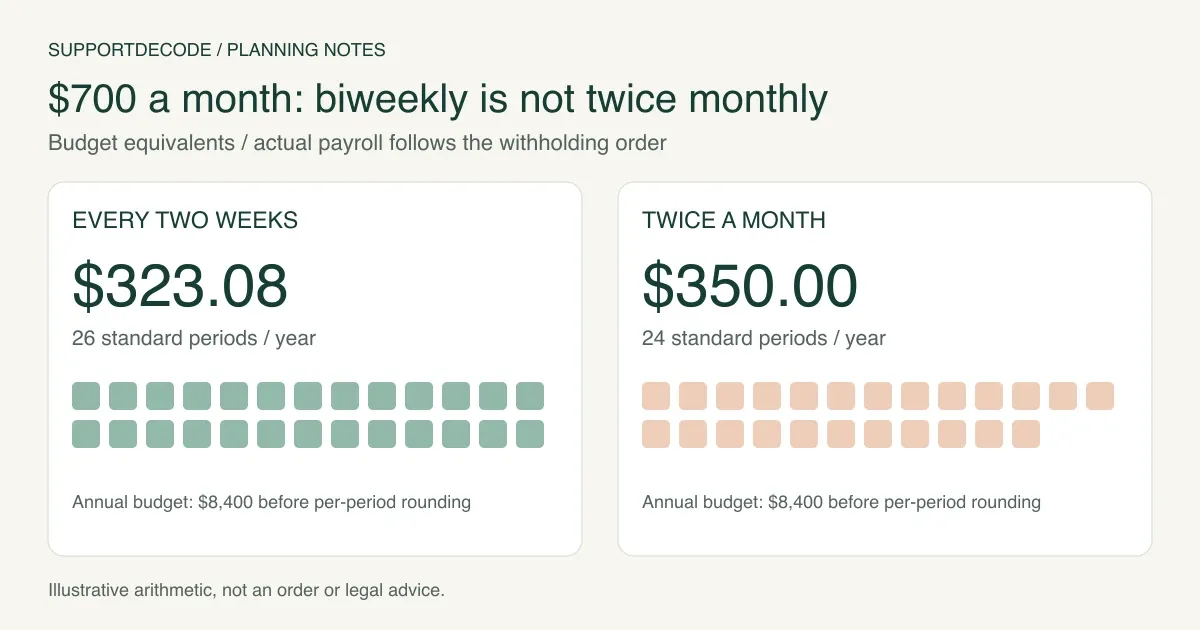
Biweekly means every two weeks. Semimonthly means twice a month. They are not interchangeable: the standard budgeting convention uses 26 biweekly periods but 24 semimonthly periods per year. Dividing a monthly child support amount by two gives a twice-monthly amount, not a biweekly amount.
This article converts an existing amount for budgeting. It does not calculate a new support obligation, authorize a different payment schedule, or tell an employer to change a deduction. The income withholding order and the issuing agency’s instructions control actual payroll withholding.
A $700 monthly child support example
First annualize the monthly amount: $700 × 12 = $8,400. Then divide that annual budget by the number of periods you want to compare.
| Frequency | Calculation | Per period |
|---|---|---|
| Monthly | $8,400 ÷ 12 | $700.00 |
| Semimonthly, twice a month | $8,400 ÷ 24 | $350.00 |
| Biweekly, every two weeks | $8,400 ÷ 26 | $323.08 |
| Weekly | $8,400 ÷ 52 | $161.54 |
The Iowa Child Support payment worksheet uses these 52/26/24/12 period counts and cautions that actual withholding may differ. That supports the conversion method, not a nationwide rule for payroll deductions. Iowa-specific withholding limits on that worksheet should not be applied to other states.
Use the child support payment frequency converter with your own existing amount. Keep the original frequency attached to the number: “$350” alone is not enough information.
Why dividing by two can overstate a biweekly budget
If you take $700 ÷ 2 and set aside $350 on each of 26 biweekly paydays, you budget $9,100, not $8,400. The difference is $700 across the year. This is a budgeting comparison, not a finding that any actual payroll deduction is wrong or that a refund is due.
For the reverse calculation, $350 every two weeks has a monthly average of $350 × 26 ÷ 12 = $758.33. The same $350 paid twice each month averages $700 monthly. Neither result tells you the date a payment is due.
A three-paycheck month is not the same as extra support
Every-two-week paydays move through calendar months. In a 26-payday year, two months have three paydays rather than two. Twice-monthly payroll normally has two scheduled pay dates each month; weekends and holidays can change when funds arrive.
A monthly average smooths those differences but does not describe each month’s cash flow. At the rounded $323.08 biweekly budget figure, two deposits total $646.16 and three total $969.24. A receiving parent’s monthly bills can remain fixed even when deposits do not arrive in equal monthly totals.
Make a dated cash-flow list alongside the average:
- Copy the scheduled paydays from the actual payroll calendar.
- Record the amounts shown in the withholding notice, keeping current support, arrears, and other items separate.
- Check payment receipt dates in the agency account, rather than assuming payday and receipt date are identical.
- Plan a buffer for timing differences where possible. Do not skip or reduce a required payment based on this comparison.
Rounding and years with 27 biweekly paydays
The unrounded result of $8,400 ÷ 26 is $323.076923…. Multiplying the displayed $323.08 by 26 gives $8,400.08. Those eight cents come from rounding each period. They are not a change in the original monthly amount. The converter preserves precision internally and rounds the displayed answer.
Some calendar years have 27 biweekly paydays, depending on the anchor date. The converter does not count those dates: it uses a fixed 26-period annual convention. Do not assume the extra paycheck is exempt, or that dividing by 27 is the authorized deduction. Ask payroll or the issuing agency how the actual order is applied to that calendar.
When the paycheck does not match this example
Start by comparing like with like. Is the order monthly or weekly? Does the deduction include arrears or another item? Are you comparing gross earnings, disposable earnings, a withholding ceiling, or the ordered amount? These are different numbers.
The state wage withholding calculators estimate a ceiling, not the automatic deduction. The arrears calculators address unpaid balances separately. To estimate a guideline amount from income and family circumstances, use the child support calculator for your state.
If the notice and payroll record appear inconsistent, gather the notice, the pay-period dates, and the deduction lines and ask the issuing agency or payroll for an explanation. Do not upload case records here; this site cannot resolve an individual withholding dispute.